

Social Feed
What is a Dish Pro? After 4 hours I don't find it in Google or the DN Wiki. Many conflicting bits of information appear that confuse me. I own 2 units marked "Dish 500" that are a single-head style that have no marking on the LNB head at all (the shape is the same as some I see advertised as "Dish Pro" but all of the single head models I see online have a big "DP" stamped on the rear of the LNB "head" and mine does not). As an example and my only personal reference to figuring this out, I look to what I have here at my home. I have access to 2 dishes, a production and a spare here at my home. Both are the style of being solid block head LNB with 4 coax connectors inside (they are not like the old style of LNBs that have coax coming out of both the 119/110 that require the combiner to feed the RG6 into the home).
So what constitutes something being a "Dish Pro" (in reference to getting a Dish Pro Separator 123254 to work with it). Again, I own two "dish 500" units that both have a solid-block-style LNB but neither have any kind of stamp on them at all, faded or otherwise with the words "Dish Pro" or the large black letters "DP". The concave dish part on both of these says only "Dish 500" .
Note: One of the LNBs has visible with a magnifying glass this number on a small sticker facing the actual dish: BSID10P20M
----------------------------------
They DO NOT look like this:
Winegard DS-5005 20" Dish 500 Antenna, Dual LNB
They DO look like this but with there is no "DP" stamped on my units (or faded image of it either):
Amazon.com: Dish Network Dish 500 Satellite Dish Assembly w/o LNBF: Electronics
Thanks!
8 Replies
·
1648 views

 .


Pub Member / Supporter

Pissed off at the crappy healthcare costs
My health Insurance renewal for 2027 just came in. Going from $827 a month to $1,187 a month. Deductible going up a $1k to $9,350. Max out of pocket also going up $1k to $11,000. Doctor co-pay of $40. Urgent Care co-pay $50. ER 50% coinsurance after deductible. That's all in network. Out of network is double, should it be needed.
Have to think about this. I'm really tempted to just go without now. I only go to the doctor once or twice a year. I pay out of pocket for Tirzepitide and can do without the Rosuvastatin (crestor) now. Really tired of spending over $10k a year and getting nothing out of it.
After years with Blue Cross I switched last year to Ambetter as my Blue Cross premium was going from $1200 to $1800 for a Silver plan and the Bronze plan was still going to be $1300 at BCBS. Ambetter was $827 for the same coverage with a Bronze plan. Didn't think it would jump this much so soon.
I'm guessing a Silver plan is probably over $2,000 a month for 2027.
50 Replies
·
701 views


Over the past few weeks, I have had problems connecting to streaming services (Netflix, HBO et al). When I go to the TV's native Channels, I have no problem. The Dish internet troubleshooter shows I have a good internet connection. I'm wondering whether it's an issue with my internet provider or a problem with the Dish software on the Hopper Plus. Anyone else seeing this?
11 Replies
·
553 views


After having continuing trouble with my eight+ year old Dell Inspiron laptop I am looking to hopefully catch a good deal on new one. My options to buy is Costco and Sam's Club. It seems like a lot of new laptops are 2 in 1 which I do not need. I use the laptop to mainly surf the web and keep up with my finances, money and bills. I would like to have at least a 15" screen and having a touchscreen is a plus. The keyboard would need to lighted also. I don't game any. It would have to be Windows instead of and not Mac. The brands I see the most are Asus, Dell and HP. My two last laptops has been Dell's. Of these brands are there any standouts over the other brands. My budget (hopefully) is $600+-. Also while researching I noticed that do not have ethernet ports.
12 Replies
·
259 views


I had an old Wireless Joey replaced by a Wireless Joey 4 (Android TV) - still have a Hopper 3 without the Hopper Plus. What do I have to do to get the EPG to show channel logos instead of "Dish"? This is annoying as hell and it's been this way for over a month…
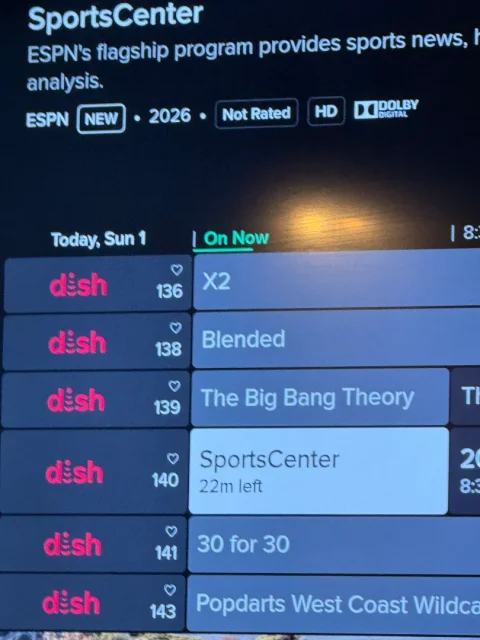
4 Replies
·
118 views


Staff member
HERE TO HELP YOU!
Cutting Edge
Sometimes a thread gets so many posts in it that is can cause issues for the server so that why today we introduce The Song Name Game Part 3!
So let the game continue!
The last song was added by Bobby who posted...
One Meat Ball - Andrews Sisters
CONTINUE ON AND HAVE FUN! WELCOME HOME TO SATELLITEGUYS.US!
Here are the original rules for the game as posted by WebbyDude back in 2006. http://www.satelliteguys.us/threads/68645-Song-Name-Game
Just name a song title and the band who performed it. The next person does the same thing, but needs to list a song title or band name which includes a word from the previous entry. Pick songs from any genre.
Example:
Long Live Rock and Roll -- Rainbow
Rainbow in the Dark -- Dio
Another example:
Ride the Lightning -- Metallica
Lightning Strikes -- Ozzy Osbourne
Get it?
An additional note: we all know that song titles, sometimes, use profane words. Because this is a family friendly website it is advised that you clean up that title up a bit. This is accomplished by using something like sh!t instead of the real word. Thanks....
68713 Replies
·
2683300 views


Pub Member / Supporter
Lifetime Supporter
Was raining yesterday so I went to Sams up in Dothan to stock up on some things. Haven't been there in quite a while. I was amazed at how large most of the TVs were. When I walked in they had a 100 in Vizio (I think it was Vizio) that was marked down to something like $1,200. The first rows of TVs were all in the 80 in + sizes. The next couple of rows had the "smaller" models....those 75 and under. I was amazed at how small the 75s looked when lined up with the larger screens.
7 Replies
·
115 views


Staff member
HERE TO HELP YOU!
161 Replies
·
3778 views
Pub Member / Supporter
7 Replies
·
985 views

Supporting Founder
Really excited for this season with Kentucky having a new coach and some really exciting recruits. Probably won't last long, but here's hoping this season is great.
184 Replies
·
3231 views

TWiT Tech Podcast Network
Time for another AWESOME video from the TWIT Network!
View: https://www.youtube.com/watch?v=-Vc6LXyvmmE
Direct YouTube Link - Home Theater Geeks 556
TWIT's Website
TWIT Live Feed
View: https://www.youtube.com/watch?v=-Vc6LXyvmmE
Direct YouTube Link - Home Theater Geeks 556
TWIT's Website
TWIT Live Feed
0 Replies
·
16 views