

Social Feed
You've answered my posts under the thread "Pre-amp or not" regarding antenna size, etc....and my particular situation with dish and hi power lines. Before I ordered the Wingard HD7080..I thought I'd better check and make sure my placement wouldn't interfer with the dishes on my roof (learned from experience to always measure twice and cut once). I put a 90" PVC pipe on the mast an set it where I was hoping to mount the mast and antenna, and sure enough...I was right into the dishes...I'd have to raise the mast an additonal 1 1/2 feet to put the antenna beam over the dishes...but I'm now concerned with running a two piece 15 foot "free standing" antenna mast with a 90" antenna on top. It can get pretty windy down here in SW Florida.
So...I am going with your original Antenna suggestion of the HD 7082 w/ HDP 269 and mounting it on a mast that I can tie into my house roof fasica. With this layout I will have to increase my cable run but approx 25 feet and use a female to female connecter to tie the extra 25 feet of RG 6 into the original 100 feet. I'll run the cable on top of my gutter to the new antenna postion.
Sound okay so far?
My question is..will the Wingard HDP 269 preamp and the HD-7082 be enough to compensate for my cable run of 125 feet RG6 outside and an additonal 100+ feet of RG6 cable loops in the house?
Since my cable run is grounded at the cable box outside (thank you Comcast)...I'm assuming I'll only have to run a ground wire from the antenna to a copper rod down the antenna mast to have everything safe and sound....true?
Have I missed anything?
Thanks in advance for your help
5 Replies
·
2733 views

Pub Member / Supporter

Pissed off at the crappy healthcare costs
My health Insurance renewal for 2027 just came in. Going from $827 a month to $1,187 a month. Deductible going up a $1k to $9,350. Max out of pocket also going up $1k to $11,000. Doctor co-pay of $40. Urgent Care co-pay $50. ER 50% coinsurance after deductible. That's all in network. Out of network is double, should it be needed.
Have to think about this. I'm really tempted to just go without now. I only go to the doctor once or twice a year. I pay out of pocket for Tirzepitide and can do without the Rosuvastatin (crestor) now. Really tired of spending over $10k a year and getting nothing out of it.
After years with Blue Cross I switched last year to Ambetter as my Blue Cross premium was going from $1200 to $1800 for a Silver plan and the Bronze plan was still going to be $1300 at BCBS. Ambetter was $827 for the same coverage with a Bronze plan. Didn't think it would jump this much so soon.
I'm guessing a Silver plan is probably over $2,000 a month for 2027.
33 Replies
·
440 views


Staff member
HERE TO HELP YOU!
Cutting Edge
Sometimes a thread gets so many posts in it that is can cause issues for the server so that why today we introduce The Song Name Game Part 3!
So let the game continue!
The last song was added by Bobby who posted...
One Meat Ball - Andrews Sisters
CONTINUE ON AND HAVE FUN! WELCOME HOME TO SATELLITEGUYS.US!
Here are the original rules for the game as posted by WebbyDude back in 2006. http://www.satelliteguys.us/threads/68645-Song-Name-Game
Just name a song title and the band who performed it. The next person does the same thing, but needs to list a song title or band name which includes a word from the previous entry. Pick songs from any genre.
Example:
Long Live Rock and Roll -- Rainbow
Rainbow in the Dark -- Dio
Another example:
Ride the Lightning -- Metallica
Lightning Strikes -- Ozzy Osbourne
Get it?
An additional note: we all know that song titles, sometimes, use profane words. Because this is a family friendly website it is advised that you clean up that title up a bit. This is accomplished by using something like sh!t instead of the real word. Thanks....
68699 Replies
·
2682328 views


I have Dish with Hopper3. I choose to get local channels OTA and had a "guide list" established at my previous home. Having moved a few miles away, I wanted to update the list by appending a couple new stations via a rescan. As many would know, some stations come in with the UHF/VHF antenna aimed in one direction, while others come in better with a different direction.
Unfortunately, when a scan is done (bringing in 25-30 stations for that particular antenna aim), the dialog screen does not present the established guide list; it presents an empty field to the right that the scanned stations may be selected one by one and added to the empty guide. But because of antenna aim, some stations originally saved are missing, and would have to be retrieved with a different antenna aim. But as I explain, if a 2nd scan is done with a different antenna aim, the stations saved from the first scan are lost.
It troubles me that Dish didn't develop software that would allow a user to simply append only 1 or 2 channels to the established list.
Any thought on this? Has anyone experienced this or heard of this from others?
1 Replies
·
40 views

After having continuing trouble with my eight+ year old Dell Inspiron laptop I am looking to hopefully catch a good deal on new one. My options to buy is Costco and Sam's Club. It seems like a lot of new laptops are 2 in 1 which I do not need. I use the laptop to mainly surf the web and keep up with my finances, money and bills. I would like to have at least a 15" screen and having a touchscreen is a plus. The keyboard would need to lighted also. I don't game any. It would have to be Windows instead of and not Mac. The brands I see the most are Asus, Dell and HP. My two last laptops has been Dell's. Of these brands are there any standouts over the other brands. My budget (hopefully) is $600+-. Also while researching I noticed that do not have ethernet ports.
8 Replies
·
132 views


Pub Member / Supporter
Lifetime Supporter
Dang female lions don't mess around when it comes to their kiddos....aka whelps.
View: https://www.youtube.com/shorts/Vvefv5xW77s?feature=share
View: https://www.youtube.com/shorts/Vvefv5xW77s?feature=share
0 Replies
·
24 views

Supporting Founder
Pub Member / Supporter
Apple Fall Hardware Event takes place today, September 9, 2026, at 10:00 a.m. PT / 1:00 p.m. ET. It marks the debut of new CEO John Ternus and the expected reveal of Apple's first foldable phone.
139 Replies
·
2038 views


Supporting Founder
Really excited for this season with Kentucky having a new coach and some really exciting recruits. Probably won't last long, but here's hoping this season is great.
180 Replies
·
3065 views


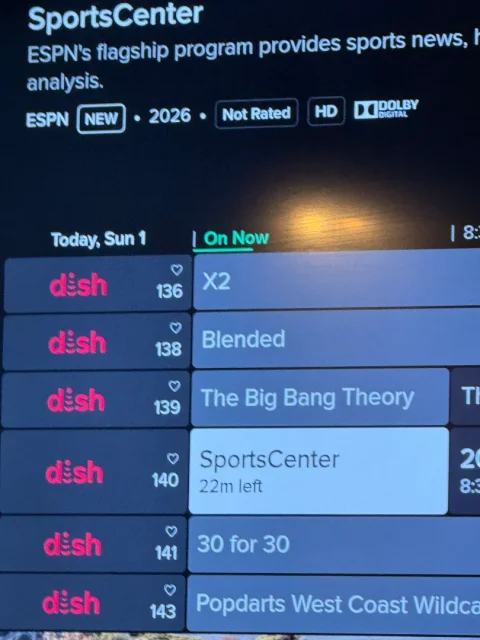
I had an old Wireless Joey replaced by a Wireless Joey 4 (Android TV) - still have a Hopper 3 without the Hopper Plus. What do I have to do to get the EPG to show channel logos instead of "Dish"? This is annoying as hell and it's been this way for over a month…
1 Replies
·
30 views





Pub Member / Supporter
Lifetime Supporter
This should hit a lot of folks with a dose of reality. I can only imagine how much more common this will get as AI progresses.
I read several stories on this and most are clear as mud. They say a lot of the stolen bitcoin has been "locked out" and that everyone will be made financially whole. I guess time will tell if either of these statements are actually true.

 www.cnbc.com
I read several stories on this and most are clear as mud. They say a lot of the stolen bitcoin has been "locked out" and that everyone will be made financially whole. I guess time will tell if either of these statements are actually true.
Hackers steal $6.3 billion from Binance in biggest-ever cryptocurrency theft
The company later added it began recovering assets impacted by the breach after pledging to cover losses using its Secure Asset Fund for Users.
www.cnbc.com
17 Replies
·
273 views
