

Social Feed
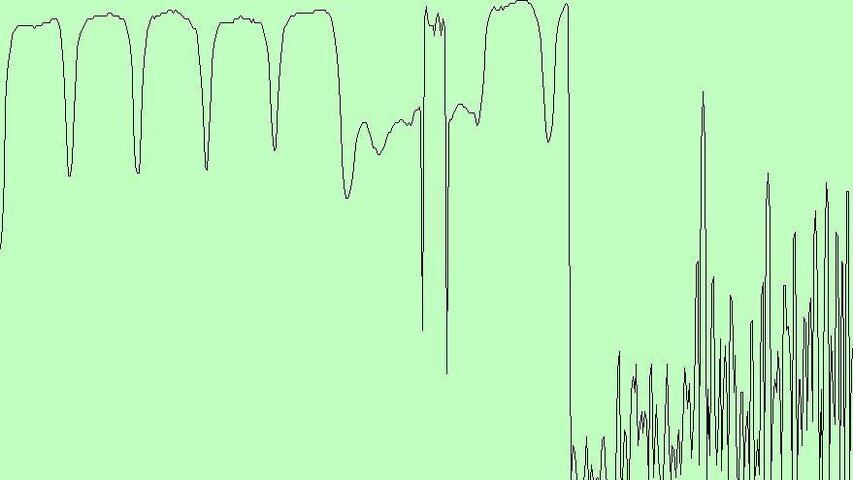
A couple days ago, I posted about how I doubled my signal on AMC6 by cutting down a few pine trees (I still have about 6 smaller ones to go). Well yesterday, I was dragging off those trees, after taking off most of the bigger limbs. After I was finished, I came inside, and was searching for some signals on C-band. I scanned one particular satellite with my Broadlogic spectrum scanner, and got the results shown below.
As you can see, about half way through the scan, the signal pretty much died, not only on the Broadlogic, but I was also monitoring on my Azbox and TT3200 at the same time, and also, the background signal went nearly to zero on my analog receiver. I thought that perhaps the LNB voltage had gone out, but I checked, and I still had voltage. I checked, however, and the LNB was no longer drawing any current.
I thought oh fooey, the LNB died. But then I remembered that when I had dragged the trees away, I had dragged them very near to where the coax comes up out of the ground going into my garage to the house. I went out and checked, and sure enough, not only had the several coaxes there been pulled to the side, a small ladder had been jammed down into the hole that the coaxes came out of. I didn't see any damage to the coax, but I figured that I had probably broken the center conductor or something.
Anyway, today, I started trouble-shooting, went outside with my meter, hooked it up to the coax that comes from the receiver.... no voltage.... until I wiggled the connector, then voltage kind of went on and off every couple seconds. This was a good 60' from the place I ran the trees into the coax, so it's completely un-related, and apparently the trees didn't do any damage after all. Then, just to make sure that the LNB was still good, I connected my meter to the coax that goes to the lnb (I have a barrel connector out at the dish to allow me to insert meters and switch coax). Well this connector also seemed bad. Ie the LNB was drawing current, but every few seconds it would jump down to zero... until I wiggled THAT connection, and I got it working steady.
I've now re-done BOTH connections by cutting off a couple inches of coax, and everything seems back to normal, but I find that it's kind of wierd that BOTH connectors that connected to this barrel connector went bad at the same time, and so suddenly. I HAVE been having trouble with C-band, ever since a big rainstorm a couple weeks ago.. no lightning, but LOTS of water, so I guess I could have gotten a lot of water into this barrel connector, even though it's enclosed in a plastic military box to protect it from the elements.
Anyway, everything back to normal, and the trees didn't get the last laugh.
As you can see, about half way through the scan, the signal pretty much died, not only on the Broadlogic, but I was also monitoring on my Azbox and TT3200 at the same time, and also, the background signal went nearly to zero on my analog receiver. I thought that perhaps the LNB voltage had gone out, but I checked, and I still had voltage. I checked, however, and the LNB was no longer drawing any current.
I thought oh fooey, the LNB died. But then I remembered that when I had dragged the trees away, I had dragged them very near to where the coax comes up out of the ground going into my garage to the house. I went out and checked, and sure enough, not only had the several coaxes there been pulled to the side, a small ladder had been jammed down into the hole that the coaxes came out of. I didn't see any damage to the coax, but I figured that I had probably broken the center conductor or something.
Anyway, today, I started trouble-shooting, went outside with my meter, hooked it up to the coax that comes from the receiver.... no voltage.... until I wiggled the connector, then voltage kind of went on and off every couple seconds. This was a good 60' from the place I ran the trees into the coax, so it's completely un-related, and apparently the trees didn't do any damage after all. Then, just to make sure that the LNB was still good, I connected my meter to the coax that goes to the lnb (I have a barrel connector out at the dish to allow me to insert meters and switch coax). Well this connector also seemed bad. Ie the LNB was drawing current, but every few seconds it would jump down to zero... until I wiggled THAT connection, and I got it working steady.
I've now re-done BOTH connections by cutting off a couple inches of coax, and everything seems back to normal, but I find that it's kind of wierd that BOTH connectors that connected to this barrel connector went bad at the same time, and so suddenly. I HAVE been having trouble with C-band, ever since a big rainstorm a couple weeks ago.. no lightning, but LOTS of water, so I guess I could have gotten a lot of water into this barrel connector, even though it's enclosed in a plastic military box to protect it from the elements.
Anyway, everything back to normal, and the trees didn't get the last laugh.
5 Replies
·
1373 views


Staff member
HERE TO HELP YOU!
House of the Dragon, the prequel to Game of Thrones, premieres on HBO Max on 8/21. I will be warching

 www.syfy.com
View: https://youtu.be/fNwwt25mheo
S~
'Game of Thrones' spinoff 'House of the Dragon' fires up release date at HBO, drops new character pics
The wait’s felt a little like watching for a dragon egg to hatch, but HBO’s hugely anticipated Game of Thrones prequel series finally has a release date. House of the Dragon will debut the first of its initial 10-episode season this summer, the network revealed today in a series of tweets that...
View: https://youtu.be/fNwwt25mheo
S~
39 Replies
·
5632 views


TWiT Tech Podcast Network
Time for another AWESOME video from the TWIT Network!
View: https://www.youtube.com/watch?v=unH0Z1jl228
Direct YouTube Link - Why New FCC Rules Could Crush Phone Privacy in the US
TWIT's Website
TWIT Live Feed
View: https://www.youtube.com/watch?v=unH0Z1jl228
Direct YouTube Link - Why New FCC Rules Could Crush Phone Privacy in the US
TWIT's Website
TWIT Live Feed
0 Replies
·
1 views
Hello everyone, new guy here. I'm trying to solve problem I'm having with Dish bonus view channels. When I'm watching the bonus view channels then I switch back to regular dish channels, after few minutes the screen flips to black and after 30 seconds flips back to regular channels and continues to flip back and forth until I turn off TV. After I wait 30 minutes and turn back on , I can use regular channels again. So, its after I switch from bonus view channels to regular dish channels the problem starts. Been trying to fix this for a month, but no luck
Here what I've done.
i contacted Dish support and they sent me a new Joey3, but no help. Switched to a different HDMI input on TV, no help. Used different HDMI cable , no help. Used different electrical wall plug, no help.
Finally got a Dish tech to check it. He ran all systems check and was OK. Finally he brought in a small TV and plugged in the HDMI out from the Joey to the small TV. He could not get the problem to occur on his small TV, so the new Joey was working OK. So, then the problem must be myTV. He made some phone calls and came back with the answer that there must be a problem with the analog to digital switch in my TV. Has anyone ever heard of a problem like this, or is it time to be looking for a new TV? My tv LG OLED65C8PUA. TV has been trouble free til now. Thanks
Here what I've done.
i contacted Dish support and they sent me a new Joey3, but no help. Switched to a different HDMI input on TV, no help. Used different HDMI cable , no help. Used different electrical wall plug, no help.
Finally got a Dish tech to check it. He ran all systems check and was OK. Finally he brought in a small TV and plugged in the HDMI out from the Joey to the small TV. He could not get the problem to occur on his small TV, so the new Joey was working OK. So, then the problem must be myTV. He made some phone calls and came back with the answer that there must be a problem with the analog to digital switch in my TV. Has anyone ever heard of a problem like this, or is it time to be looking for a new TV? My tv LG OLED65C8PUA. TV has been trouble free til now. Thanks
5 Replies
·
73 views

Hi all, I recently inherited a FTA system off Craiglist and have been trying to get it set up. What I got was a Glorystar-branded ~90cm offset dish with a ground mount (/flat roof) frame, and GEOSATpro DSR200c receiver. From that initial equipment, I've replaced the old LNBF with a (cheap!) new one and also splurged on an SG-2100 H-H motorized rotor which does respond from the receiver's USALS menu.
The previous owner had it set up for religious programming on Galaxy 19 and I've been trying to start by finding that same bird at least. After a couple sessions I'm not sure I have, but I've found *something* at least! A handful of motor ticks further than the dish wants to be for 97W after starting from motor 0 pointing as much south as I can guess at. (I don't have great references to aim for and it's really hard to sight where exactly the dish is pointing anyway….)
Anyway, so far there's only one transponder that I've ever been able to catch as I search. It's 12146 V and when the receiver scans it I get this list of video channels:
 but it's a long-winded spiel about "you know us as an industry-leading satellite solutions provider with over a quarter million sites" and to call them For All Your Every Needs™ type thing.
While I get little blips from other frequencies, this is the only strong transponder I've been able to come across. My receiver shows it as S 75 and Q up to 85 when I adjust it. It actually seemed to get better as I **un**skewed my LBNF — iiuc G19 was supposed to be -20º for me but however I'm supposed to be reading/referencing the angles the puck is now basically at 0º relative to the dish/arm got the strongest on this transponder.
Anyway sorry this is so long winded already… my question is, do I even have the right satellite? None of the other transponders that are supposed to be active on G-19 seem to come in. And if not the right satellite does anyone happen to recognize which one I might have found instead? I think knowing that would help me then adjust for a truer south aim and then hopeful the USALS will work automatically once I can get it dialed in.
The previous owner had it set up for religious programming on Galaxy 19 and I've been trying to start by finding that same bird at least. After a couple sessions I'm not sure I have, but I've found *something* at least! A handful of motor ticks further than the dish wants to be for 97W after starting from motor 0 pointing as much south as I can guess at. (I don't have great references to aim for and it's really hard to sight where exactly the dish is pointing anyway….)
Anyway, so far there's only one transponder that I've ever been able to catch as I search. It's 12146 V and when the receiver scans it I get this list of video channels:
- 1.1 Srv_1
- 2.84 OU_Chan
- 3.2 Srv_2
- 4.5 Srv_5
- 5.3 Srv_3
- 6.4 Srv_4
- 7.6 Srv_6
- 8.7 Srv_7
but it's a long-winded spiel about "you know us as an industry-leading satellite solutions provider with over a quarter million sites" and to call them For All Your Every Needs™ type thing.While I get little blips from other frequencies, this is the only strong transponder I've been able to come across. My receiver shows it as S 75 and Q up to 85 when I adjust it. It actually seemed to get better as I **un**skewed my LBNF — iiuc G19 was supposed to be -20º for me but however I'm supposed to be reading/referencing the angles the puck is now basically at 0º relative to the dish/arm got the strongest on this transponder.
Anyway sorry this is so long winded already… my question is, do I even have the right satellite? None of the other transponders that are supposed to be active on G-19 seem to come in. And if not the right satellite does anyone happen to recognize which one I might have found instead? I think knowing that would help me then adjust for a truer south aim and then hopeful the USALS will work automatically once I can get it dialed in.
9 Replies
·
256 views


TWiT Tech Podcast Network
Time for another AWESOME video from the TWIT Network!
View: https://www.youtube.com/watch?v=wW3qReY-JYA
Direct YouTube Link - Google's New Translate Tool
TWIT's Website
TWIT Live Feed
View: https://www.youtube.com/watch?v=wW3qReY-JYA
Direct YouTube Link - Google's New Translate Tool
TWIT's Website
TWIT Live Feed
0 Replies
·
5 views
TWiT Tech Podcast Network
Time for another AWESOME video from the TWIT Network!
View: https://www.youtube.com/watch?v=-zh1RgcJue0
Direct YouTube Link - Another Cisco SD-WAN 0-day?
TWIT's Website
TWIT Live Feed
View: https://www.youtube.com/watch?v=-zh1RgcJue0
Direct YouTube Link - Another Cisco SD-WAN 0-day?
TWIT's Website
TWIT Live Feed
0 Replies
·
4 views
I'm having trouble finding a for sure answer on this. When I first started diving back into satellite stuff I noticed the GT Media V8 Finder2 which looks pretty cool and relatively low price point. But I can't find an answer, seems like some people (and Amazon's own AI guesser-bot) say it doesn't support motors.
The manual itself (the PDF that I found is named 20220718043903GTMEDIAV8FINDER2.pdf and it's on page 6 of 8) does show on the installation screen a "Motor Setup" menu item and says "If select DiSEqC1.2 or USALS, we can press ◀︎▶︎ to select IF Channel, and use number key to input Center Frequency."
Which…… the USALS part seems promising, but I don't know what IF and Center frequencies have to do with anything? Can it drive the motor off its battery for one, and does it have options for e.g. using the ◀︎▶︎ arrows to change the aim and save adjustments?
The closest I've found to real-world experience here is in Long shot with TBS6909X card where someone is talking about a different rotor and says:
> when I connect my V8 Finder 2, it immediately moves the dish if it's not in the correct position
which seems really promising! Moving the dish is what I'm after here, with something newer than the old MPEG-2 receiver I have now. Even for other receivers its really unclear if motor support is just pretty much a safe assumption that they don't even mention it anymore?
The V9 Prime actually looks pretty nice too and assuming it runs motors maybe that'd be better than the V8 Finder 2 for actual long term use since it has networking. But I'm having trouble finding listings for it (and actually most other receivers I see mentioned here) on Amazon or eBay or even Aliexpress. I'm wanting a DVB-S2 receiver for at least MPEG-4 with H.264/AVC and maybe should just get H.265/HEVC while I'm shopping. Main criteria:
* run my "Goto X"-era SG-2100 rotator
* be able to view most/all modern FTA satellites
* ideally a scheduled DVR feature and/or network would make it more useful
* I don't mind if it has… "alternative" firmwares or features but just for broader compatibility/interest
My main goal is I guess just exploration, seeing what's up there. Honestly not a big TV guy and definitely not into infomercials but if I can time shift the occasional Bob Ross or Mr. Rogers Neighborhood, or catch some world events as they're being uplinked, that sort of thing might be interesting. (Honestly main goal started out as weather satellites but this is kinda a warmup excercise for what will likely be a separate setup due to the frequencies.)
My dish is kinda far from my house and even farther from my "radio shack" so if I could just run a PoE ethernet line to something in a box below the dish, or a coax only to the crawlspace where I have 110V but either way would need it full remote including changing between satellites. To avoid having to buy and pull tons more coax up and down through the house. I'm into open source and real standards, so I'd much rather something that I can say use with VLC or go2rtc via a raw IP address and protocol rather than some convenient but proprietary iOS cloud app thingy.
The manual itself (the PDF that I found is named 20220718043903GTMEDIAV8FINDER2.pdf and it's on page 6 of 8) does show on the installation screen a "Motor Setup" menu item and says "If select DiSEqC1.2 or USALS, we can press ◀︎▶︎ to select IF Channel, and use number key to input Center Frequency."
Which…… the USALS part seems promising, but I don't know what IF and Center frequencies have to do with anything? Can it drive the motor off its battery for one, and does it have options for e.g. using the ◀︎▶︎ arrows to change the aim and save adjustments?
The closest I've found to real-world experience here is in Long shot with TBS6909X card where someone is talking about a different rotor and says:
> when I connect my V8 Finder 2, it immediately moves the dish if it's not in the correct position
which seems really promising! Moving the dish is what I'm after here, with something newer than the old MPEG-2 receiver I have now. Even for other receivers its really unclear if motor support is just pretty much a safe assumption that they don't even mention it anymore?
The V9 Prime actually looks pretty nice too and assuming it runs motors maybe that'd be better than the V8 Finder 2 for actual long term use since it has networking. But I'm having trouble finding listings for it (and actually most other receivers I see mentioned here) on Amazon or eBay or even Aliexpress. I'm wanting a DVB-S2 receiver for at least MPEG-4 with H.264/AVC and maybe should just get H.265/HEVC while I'm shopping. Main criteria:
* run my "Goto X"-era SG-2100 rotator
* be able to view most/all modern FTA satellites
* ideally a scheduled DVR feature and/or network would make it more useful
* I don't mind if it has… "alternative" firmwares or features but just for broader compatibility/interest
My main goal is I guess just exploration, seeing what's up there. Honestly not a big TV guy and definitely not into infomercials but if I can time shift the occasional Bob Ross or Mr. Rogers Neighborhood, or catch some world events as they're being uplinked, that sort of thing might be interesting. (Honestly main goal started out as weather satellites but this is kinda a warmup excercise for what will likely be a separate setup due to the frequencies.)
My dish is kinda far from my house and even farther from my "radio shack" so if I could just run a PoE ethernet line to something in a box below the dish, or a coax only to the crawlspace where I have 110V but either way would need it full remote including changing between satellites. To avoid having to buy and pull tons more coax up and down through the house. I'm into open source and real standards, so I'd much rather something that I can say use with VLC or go2rtc via a raw IP address and protocol rather than some convenient but proprietary iOS cloud app thingy.
3 Replies
·
119 views
TWiT Tech Podcast Network
Time for another AWESOME video from the TWIT Network!
View: https://www.youtube.com/shorts/VVvKL573guE
Direct YouTube Link - AI That Learns YOU! Jensen Huang Loves It! #shorts
TWIT's Website
TWIT Live Feed
View: https://www.youtube.com/shorts/VVvKL573guE
Direct YouTube Link - AI That Learns YOU!
Jensen Huang Loves It! #shortsTWIT's Website
TWIT Live Feed
0 Replies
·
4 views
TWiT Tech Podcast Network
Time for another AWESOME video from the TWIT Network!
View: https://www.youtube.com/shorts/ctuZx2SesL0
Direct YouTube Link - AI Worm: The Unstoppable Cybersecurity Threat Explained #shorts
TWIT's Website
TWIT Live Feed
View: https://www.youtube.com/shorts/ctuZx2SesL0
Direct YouTube Link - AI Worm: The Unstoppable Cybersecurity Threat Explained #shorts
TWIT's Website
TWIT Live Feed
0 Replies
·
4 views
Lon.TV
Time for another AWESOME video from Lon Seidman of LON.TV!
View: https://www.youtube.com/watch?v=ZZX9ePUKo00
Direct YouTube Link - Let's Talk About Windows 11's Bloated Notepad and a Fix!
The Official LON.TV Website
Lon on Facebook
View: https://www.youtube.com/watch?v=ZZX9ePUKo00
Direct YouTube Link - Let's Talk About Windows 11's Bloated Notepad and a Fix!
The Official LON.TV Website
Lon on Facebook
0 Replies
·
6 views