

Social Feed
This article from TWICE:
http://www.twice.com/article/CA479247.html?display=breaking+news
It has a few more details than we've heard thus far .
http://www.twice.com/article/CA479247.html?display=breaking+news
It has a few more details than we've heard thus far .
16 Replies
·
3802 views


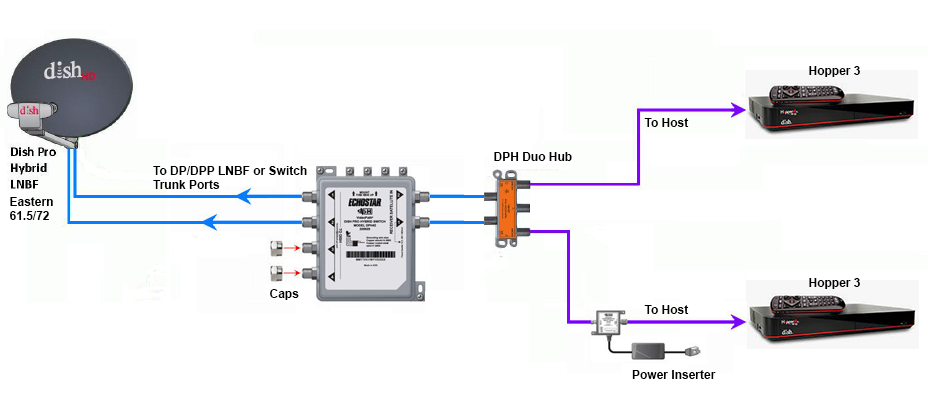
Does someone still have the diagram showing how to connect two Hopper 3s again?
I currently have one H3 and one 4K Joey, set up through a 1000.2 eastern arc hybrid lnb and solo hub.
The plan is to replace the Joey with the second H3. Already purchased a duo hub and I have three coax cables coming in from outside, from back when I used to have the older 1000.4 dish and the hopper 2. I don't fully remember, but I think the other two coax cables are just tied up next to the dish outside; will have to check again.
24 Replies
·
5637 views




Over the past few weeks, I have had problems connecting to streaming services (Netflix, HBO et al). When I go to the TV's native Channels, I have no problem. The Dish internet troubleshooter shows I have a good internet connection. I'm wondering whether it's an issue with my internet provider or a problem with the Dish software on the Hopper Plus. Anyone else seeing this?
0 Replies
·
18 views

Staff member
HERE TO HELP YOU!
Cutting Edge
Sometimes a thread gets so many posts in it that is can cause issues for the server so that why today we introduce The Song Name Game Part 3!
So let the game continue!
The last song was added by Bobby who posted...
One Meat Ball - Andrews Sisters
CONTINUE ON AND HAVE FUN! WELCOME HOME TO SATELLITEGUYS.US!
Here are the original rules for the game as posted by WebbyDude back in 2006. http://www.satelliteguys.us/threads/68645-Song-Name-Game
Just name a song title and the band who performed it. The next person does the same thing, but needs to list a song title or band name which includes a word from the previous entry. Pick songs from any genre.
Example:
Long Live Rock and Roll -- Rainbow
Rainbow in the Dark -- Dio
Another example:
Ride the Lightning -- Metallica
Lightning Strikes -- Ozzy Osbourne
Get it?
An additional note: we all know that song titles, sometimes, use profane words. Because this is a family friendly website it is advised that you clean up that title up a bit. This is accomplished by using something like sh!t instead of the real word. Thanks....
68649 Replies
·
2679789 views


Lifetime Supporter
I know HipKat said that they were working on conversions but we got the official news yesterday right from Dish that starting next month all DMA's will be on the western arc, and all customers will be assigned to that. That's gonna mean a lot of customers around here aren't gonna get Dish unless there are exceptions. Too many mountains and trees.
176 Replies
·
5251 views


Pub Member / Supporter
Lifetime Supporter
5 Replies
·
114 views

Supporting Founder
Really excited for this season with Kentucky having a new coach and some really exciting recruits. Probably won't last long, but here's hoping this season is great.
173 Replies
·
2617 views


Interesting article about the work being done to develope an ATSC 3 converter box. Yes it does mention affordable.

 www.tvtechnology.com
Pearl TV Issues Progress Report on Low-Cost 3.0 Converters in Advance of NAB Show New York
Group has secured lower pricing from key tech players to make less costly boxes available
www.tvtechnology.com
12 Replies
·
669 views


Pub Member / Supporter
Lifetime Supporter
1 Replies
·
89 views

Pub Member / Supporter

Susan Saint James, Emmy-Winning Star of ‘Kate & Allie’ and ‘McMillan & Wife,’ Dies at 80
Susan Saint James, the Emmy-winning actress who starred in "Kate & Allie," died Monday after being diagnosed with pancreatic cancer. She was 80.
 variety.com
7 Replies
·
105 views


Supporting Founder
Pub Member / Supporter
Apple Fall Hardware Event takes place today, September 9, 2026, at 10:00 a.m. PT / 1:00 p.m. ET. It marks the debut of new CEO John Ternus and the expected reveal of Apple's first foldable phone.
136 Replies
·
1748 views
 . can we say over priced garbage!!!

