

Social Feed

What are the disadvantages of the orthomode feedhorns? After doing some reading, I'm not finding much negative other than availablility and price. I'm mainly thinking C band. From what I have read many people report gains using them in place of more common feeds such as polarotors or LNBFs on the BUDs.
I'm surprised that no one considers selling them with today's low priced switches and LNBs. The design is so simple someone could manufacture them easily, but the available commercial units are rather steeply priced. I think somone's missing the opportunity with this.
I have 3 commercial VSAT transmitter type orthomode tranducers from my Prodelin dishes and after studying the design, I was toying with the idea of refitting them to see if they could work with other LNBs. They have nice conical scalars built into the front. Now that I have a third setup to experiment with for the offset design feedhorns.
32 Replies
·
9216 views


Staff member
HERE TO HELP YOU!
What shows are you Streaming or watching on Broadcast, Satellite or Cable?
706 Replies
·
72348 views


Booredatwork.com
Time for another AWESOME video from BoredAtWork!
View: https://www.youtube.com/shorts/juTfldN6KVg
Direct YouTube Link - Motorola Signature 27 Unboxing!
Booredatwork.com Website
Booredatwork on Facebook
View: https://www.youtube.com/shorts/juTfldN6KVg
Direct YouTube Link - Motorola Signature 27 Unboxing!
Booredatwork.com Website
Booredatwork on Facebook
0 Replies
·
1 views

Help! Double pops, quite loud, are driving me crazy on my Buckeye Hypex NCx500 3 channel amp, only on DISH sources. 7.2.4
Every time the program source changes from a commercial back to a program or vice vs I get 2 loud pops. Where it was once occasional, it's now all the time. Kicker is I did not have these issues with previous external LCR amps/pre-amp out nor the internal A/B amps in my Anthem MRX1140 that was driving LCR a while back.
DISH Tech stayed with me on the phone linking my unit to them about a month ago but it didn't help.
Beginning to think I've got a bad unit or is a software update issue?
Am using new 1.5' Monoprice XLR->RCA cables.
0 Replies
·
12 views

Staff member
Pub Member / Supporter
Cutting Edge
The TPN Map Excel Presents all DIRECTV Channels:
Understanding the TPN Map
Making Sense of the TPN Map Display Conventions
National (50-States or wide/NAT+PR beams)
Local (Local-Into-Local or narrow/Spot beams)
Local (Local-Into-Local or narrow/Spot beams)
Additional tabs provide:
OTA the (Over-The-Air) Database
VOD (Video On_Demand) Records
Offline Records
Engr Records
Net Decoder a graphic presentation of all satellites and transponders
VOD (Video On_Demand) Records
Offline Records
Engr Records
Net Decoder a graphic presentation of all satellites and transponders
Domestic Satellites
@99W...... D11, D14
@101W.... D16
@103W.... D12, D15
@110W.... D5
@119W.... D8
@99W...... D11, D14
@101W.... D16
@103W.... D12, D15
@110W.... D5
@119W.... D8
Understanding the TPN Map
Making Sense of the TPN Map Display Conventions
2194 Replies
·
982599 views
I moved my H3 from the Coach to the Park Model and the signal is weak. On the Coach I had the Winegard Trav'ler. At the Park Model I got a fixed dish setup from Solid Signal. DISH Network Triple LNB HD Western Arc (VOOM) Dish Antenna(DISH1000.2). Just couldn't get it to pickup a signal. Took the LNB from the Coach and I got a signal that gave me service but the slightest foul weather it was out. Apparently the LNB from Solid Signal was a Reman piece. I complained and they refunded me. So now I'm thinking that my Coach LNB is getting weak and I should get a new one. From what I've read here that any that you get for DISH is Reman even if it says that it's new it's a Reman? How do I tell if my LNB is 100%? And what I'm buying is good too. Do the LNB's fail because of sun damage to the white horns on them? The two triple LNBs I see are the 145511 and the 151027 Hybrid? (I think I have this one). My system consists of the above dish and LNB, a DPH42 Switch and a power inserter and a splitter node then to the H3 receiver. Thoughts? Thanks
4 Replies
·
222 views


Staff member
HERE TO HELP YOU!
Cutting Edge
Sometimes a thread gets so many posts in it that is can cause issues for the server so that why today we introduce The Song Name Game Part 3!
So let the game continue!
The last song was added by Bobby who posted...
One Meat Ball - Andrews Sisters
CONTINUE ON AND HAVE FUN! WELCOME HOME TO SATELLITEGUYS.US!
Here are the original rules for the game as posted by WebbyDude back in 2006. http://www.satelliteguys.us/threads/68645-Song-Name-Game
Just name a song title and the band who performed it. The next person does the same thing, but needs to list a song title or band name which includes a word from the previous entry. Pick songs from any genre.
Example:
Long Live Rock and Roll -- Rainbow
Rainbow in the Dark -- Dio
Another example:
Ride the Lightning -- Metallica
Lightning Strikes -- Ozzy Osbourne
Get it?
An additional note: we all know that song titles, sometimes, use profane words. Because this is a family friendly website it is advised that you clean up that title up a bit. This is accomplished by using something like sh!t instead of the real word. Thanks....
68965 Replies
·
2707818 views


The box always worked SORTOF but lately , I was unable to tune in channels.
Someone here suggested a new power supply. Good suggestion. It worked a little better for a little while but after warming up NO CHANNELS. Warming up? Maybe it needs better cooling. So I hacked it and installed a fan. See photo.
That only worked for a 15-20 minutes. Can anyone guess what the real problem was?
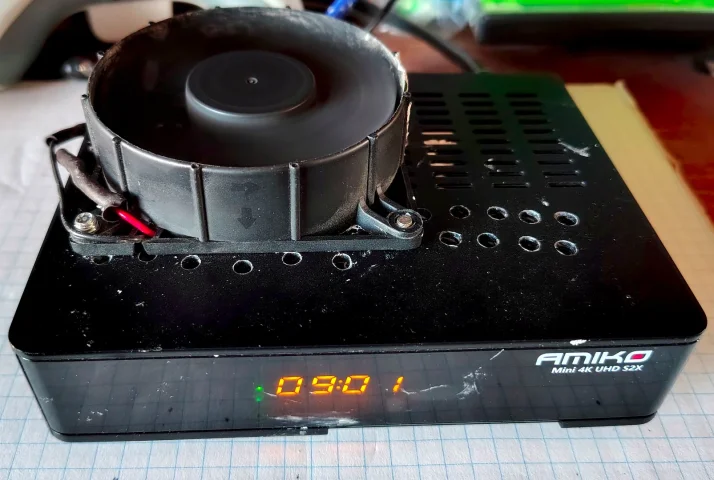
5 Replies
·
137 views


iJustine
Time for another AWESOME video from iJustine!
View: https://www.youtube.com/watch?v=Hb-43HIZDZA
Direct YouTube Link - Meet the Antigravity A1 Follow Me Bundle!
The official iJustine Website's Website
Buy her book!
View: https://www.youtube.com/watch?v=Hb-43HIZDZA
Direct YouTube Link - Meet the Antigravity A1 Follow Me Bundle!
The official iJustine Website's Website
Buy her book!
0 Replies
·
20 views
TWiT Tech Podcast Network
Time for another AWESOME video from the TWIT Network!
View: https://www.youtube.com/watch?v=aSfXGYmL9o0
Direct YouTube Link - DNS Blocked! Why Quad9's Exit from France Is a Big Deal
TWIT's Website
TWIT Live Feed
View: https://www.youtube.com/watch?v=aSfXGYmL9o0
Direct YouTube Link - DNS Blocked! Why Quad9's Exit from France Is a Big Deal
TWIT's Website
TWIT Live Feed
0 Replies
·
17 views