


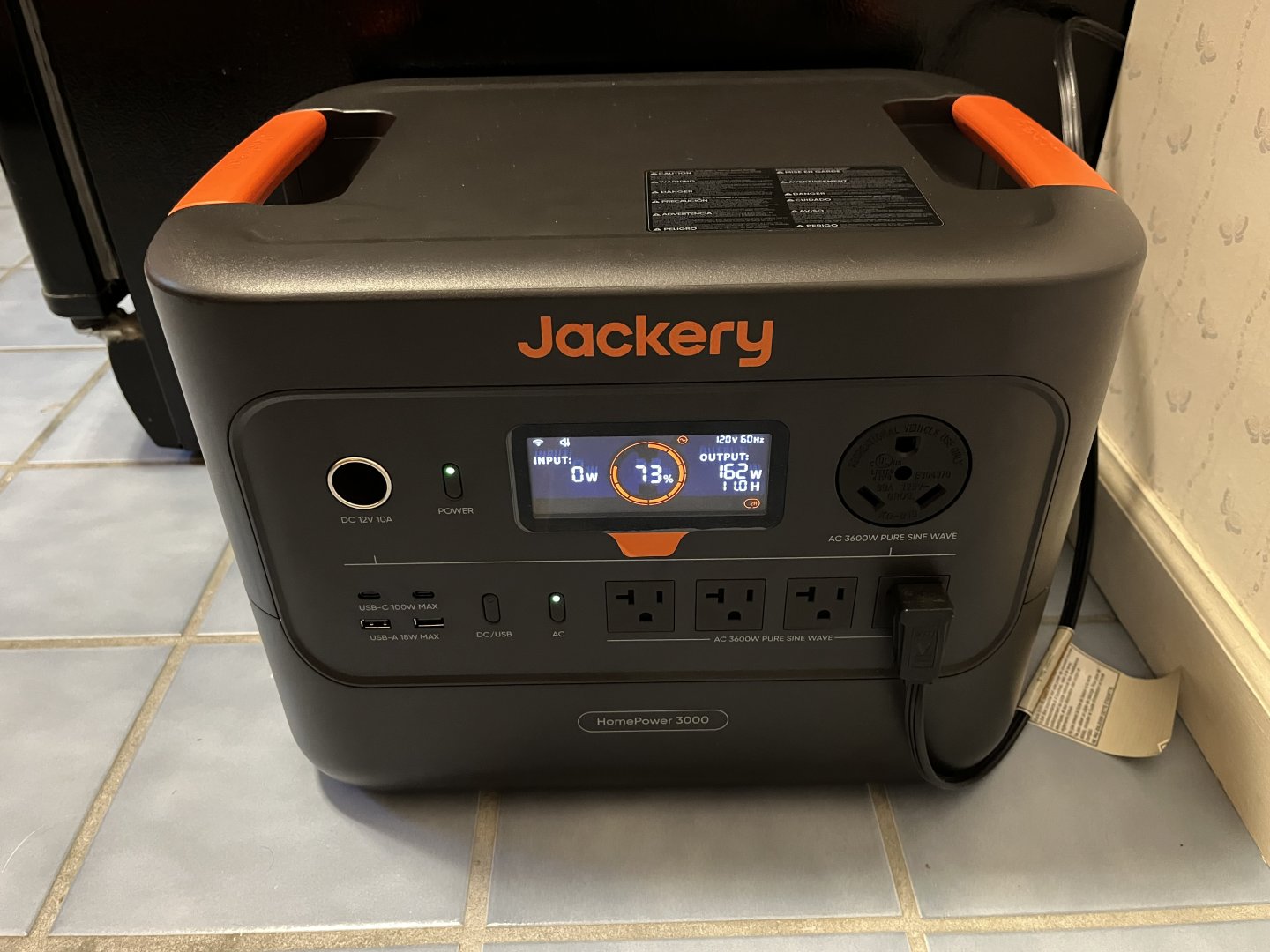
I've been using APC UPS units to protect my computer and Home Theater equipment for many years, but now there are a number of companies producing "Glamping" power accessories that can provide hours of 120 VAC power for off-grid use at a camp site or a few hours of power when severe weather knock out the power. I had mentioned elsewhere that I picked up a Jackery HomePower 3000 to use instead of a gasoline generator to provide emergency power for our refrigerator. The 3.0 kWh of Lithium Iron Phosphate battery cells can supply power for over 24 hours and is "light" enough that I can move it into the kitchen to allow it to power the fridge. However, it's not an automatic operation, as I need to move it from its home in the closet to the kitchen, in addition to rolling the refrigerator out from its alcove so I can plug it in.
 The Jackery wasn't my first LFP Power Bank; I had purchased an EcoFlow River 2 unit with 512 Wh of capacity. I had purchased this to use on our Home LAN to give it a longer run time than the three hours that I had with the APC UPS I had been using. This isn't an odd use case, EcoFlow advertises this capability on its website and a transfer time of 16 mS. I used this River 2 to supply power to a 16-port Cisco gigabit switch, the AT&T router, Printer Server, MoCA adapter, and surveillance camera NAS. All told, about 35 W of load. With the EcoFlow River 2, it reported approximately 12-13 hours of run time. So far, so good.
After it had been in use for a month or so, I was down in the basement and heard a whirling sound. Turns out the State of Charge was 24% and it appeared the River 2 was off-grid even though it was still plugged in. Well, turns out that the firmware had a big bug in it for people that were using it like I was. I communicated with EcoFlow and eventually they sent a newer firmware that fixed this problem. But before they fixed it, I decided that I had such a good experience with the Jackery, that I bought their Explorer 1000 (1,070 Wh capacity) which should run our home network for over a day. It worked great right out of the box, and even when it was charging, the cooling fan was practically silent.
After the River 2 was patched, I put it to work, replacing the APC UPS powering the bedroom TV with Dish 4K Joey and Apple TV. The LG OLED uses quite a lot more power than I expected, depending on the scene, it can have a 120 Watt power draw. With the River 2, that might limit power-out watching to 4-5 hours. Also, the River 2 still had the issue with its cooling fan, I find it disturbing the quiet bedroom environment.
EcoFlow had one of the Spring sales and have a new EcoFlow Delta 3 1000 Air which was on sale for $299. That's a 960 Wh capacity power bank with a 10 ms power switching, so this seemed like a perfect solution. Well, except for two things: 1) It has one grounded NEMA 5-15 receptacle; 2) even though EcoFlow claims "35 dB @ 1m" quietness, it was even louder that the River 2 was. Not optimal!
So, I ended up swapping the Jackery Explorer 1000 with the EcoFlow Delta 3 1000 Air since the power demands for the Home LAN are less, and the loud fan noise won't bother anyone. The bedroom TV setup says it should be good for approximately 7 hours:

I realize that at some point the amount of money spent on these individual long-term Power Backup solutions will be more expensive than if we just bought a whole-house power solution. Those are coming down in price, but we're still looking at $16,000 at a minimum for a LFP solution, and $10,000 or so for a home LP generator solution. (With the LP generator solution, we would need to also pay the Gas utility to increase the size of our gas line, so that tilts me towards a the battery solution.)
Finally, I tried an Amazon 12 VDC LFP battery that replaces the Lead Acid Gel Cell in a normal UPS with an equivalent set of LFP cells. The price was roughly the same as a 12 VDC battery from Batteries+, and it's been running for about a year now with no difficulty. But these APC UPS units won't run for long, and are really intended to allow the powered equipment to be shut down in an orderly manner.
So, am I weird to use these Camping power banks for Home emergency power solutions? I haven't even touched the idea of Solar panels to supplement the run time in an Outage.
After it had been in use for a month or so, I was down in the basement and heard a whirling sound. Turns out the State of Charge was 24% and it appeared the River 2 was off-grid even though it was still plugged in. Well, turns out that the firmware had a big bug in it for people that were using it like I was. I communicated with EcoFlow and eventually they sent a newer firmware that fixed this problem. But before they fixed it, I decided that I had such a good experience with the Jackery, that I bought their Explorer 1000 (1,070 Wh capacity) which should run our home network for over a day. It worked great right out of the box, and even when it was charging, the cooling fan was practically silent.
After the River 2 was patched, I put it to work, replacing the APC UPS powering the bedroom TV with Dish 4K Joey and Apple TV. The LG OLED uses quite a lot more power than I expected, depending on the scene, it can have a 120 Watt power draw. With the River 2, that might limit power-out watching to 4-5 hours. Also, the River 2 still had the issue with its cooling fan, I find it disturbing the quiet bedroom environment.
EcoFlow had one of the Spring sales and have a new EcoFlow Delta 3 1000 Air which was on sale for $299. That's a 960 Wh capacity power bank with a 10 ms power switching, so this seemed like a perfect solution. Well, except for two things: 1) It has one grounded NEMA 5-15 receptacle; 2) even though EcoFlow claims "35 dB @ 1m" quietness, it was even louder that the River 2 was. Not optimal!
So, I ended up swapping the Jackery Explorer 1000 with the EcoFlow Delta 3 1000 Air since the power demands for the Home LAN are less, and the loud fan noise won't bother anyone. The bedroom TV setup says it should be good for approximately 7 hours:
I realize that at some point the amount of money spent on these individual long-term Power Backup solutions will be more expensive than if we just bought a whole-house power solution. Those are coming down in price, but we're still looking at $16,000 at a minimum for a LFP solution, and $10,000 or so for a home LP generator solution. (With the LP generator solution, we would need to also pay the Gas utility to increase the size of our gas line, so that tilts me towards a the battery solution.)
Finally, I tried an Amazon 12 VDC LFP battery that replaces the Lead Acid Gel Cell in a normal UPS with an equivalent set of LFP cells. The price was roughly the same as a 12 VDC battery from Batteries+, and it's been running for about a year now with no difficulty. But these APC UPS units won't run for long, and are really intended to allow the powered equipment to be shut down in an orderly manner.
So, am I weird to use these Camping power banks for Home emergency power solutions? I haven't even touched the idea of Solar panels to supplement the run time in an Outage.
Last edited:


