

Why my FTA box stopped working?

Advertisements

techristian

Member
Original poster
Sep 23, 2026
12
6
Windsor
The box always worked SORTOF but lately , I was unable to tune in channels.
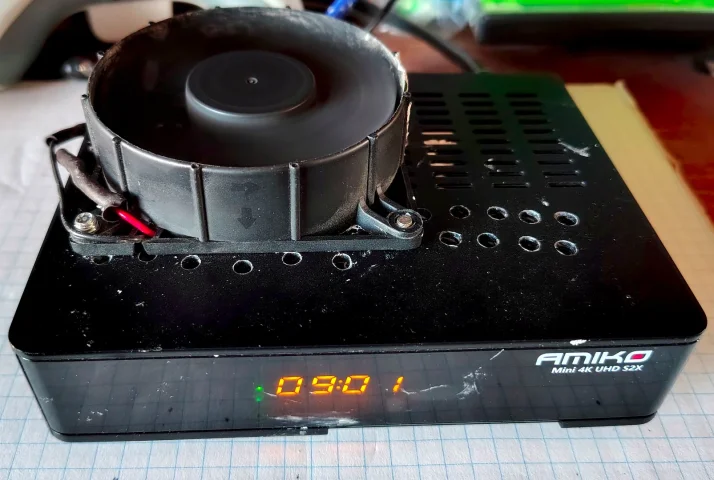
Someone here suggested a new power supply. Good suggestion. It worked a little better for a little while but after warming up NO CHANNELS. Warming up? Maybe it needs better cooling. So I hacked it and installed a fan. See photo.
That only worked for a 15-20 minutes. Can anyone guess what the real problem was?
 

Attachments

  • amiko.webp
    amiko.webp
    218.8 KB · Views: 19
  • Like
Reactions: FTA4PA
The box always worked SORTOF but lately , I was unable to tune in channels.
Someone here suggested a new power supply. Good suggestion. It worked a little better for a little while but after warming up NO CHANNELS. Warming up? Maybe it needs better cooling. So I hacked it and installed a fan. See photo.
That only worked for a 15-20 minutes. Can anyone guess what the real problem was?

I had to add a fan to a Chinese box once to keep it from overheating (thread here somewhere) but that was an issue new out of the box. What was the issue with your Amiko receiver?
 
How did you power the fan? Not by sourcing from the power adapter or receiver, hopefully.

Can you describe the problem symptom in more detail? How do you know it is/was a receiver issue and not related to the dish orientation?
I have a new much more BEEFY power supply. 3-4 amps

Dan
 
I had to add a fan to a Chinese box once to keep it from overheating (thread here somewhere) but that was an issue new out of the box. What was the issue with your Amiko receiver?
It wasn't the receiver even though I thought it was, but adding the fan will lengthen the life of the box.
 
My money is on the LNB, not the box — especially since you say it wasn't the receiver.

That 15-20 minute pattern is classic for an LNB drifting as it warms up: it works cold, then the local oscillator drifts off frequency and the receiver can't lock anything, so you get 'no channels' even though signal strength still looks fine. A fan on the box won't touch that, because the part overheating is out on the dish.

A couple of quick checks that would confirm it before you replace anything:
- When it dies, go into the signal meter and note signal strength vs. signal quality on a known transponder, then compare the same transponder cold the next morning. Strength staying up while quality drops to zero points at the LNB, not the box.
- If you can, swap in any known-good LNB, even a spare, and see if it stays locked past the 20-minute mark. Or move the box to another dish/feed if you have one.
- While you're up there, check the coax connectors for green corrosion or water inside the boot, and make sure the dish hasn't shifted slightly — a marginal alignment looks exactly like this too, working when conditions are perfect and dropping out as things warm up and expand.

If the LNB is the culprit, check the feedhorn cap as well — a cracked or sun-baked cap lets moisture in, and that kills LNBs slowly exactly like this.

Curious what you found — was it the LNB in the end?
 
  • Like
Reactions: AZ.
My money is on the LNB, not the box — especially since you say it wasn't the receiver.

That 15-20 minute pattern is classic for an LNB drifting as it warms up: it works cold, then the local oscillator drifts off frequency and the receiver can't lock anything, so you get 'no channels' even though signal strength still looks fine. A fan on the box won't touch that, because the part overheating is out on the dish.

I have 4 dishes now connected through an 8 way switch. I used to have 7 dishes. I will remember what you said about the LNB heating up. I also had a non standard 2 way switch in the mix which worked for YEARS as a coupler. I removed THAT and replaced it with a copper coupler, replaced the 8 way switch with a 4 way switch and the problem seems to be gone. 3 ku dishes and 1 C band. The 8 way may still be good, but I pulled it out anyway.

My SWITCH has been in the garage for at least the past 10 years. This is to keep it from rain and snow.

Dan
 
  • Like
Reactions: navychop
My guess would be the switch, not the box.

You mentioned in your other thread that you have four dishes running through an 8-way switch that has been sitting in the garage for at least ten years. That is the one part of the chain you have not swapped yet, and it fits the pattern perfectly: everything works for 15 to 20 minutes, then as the switch itself warms up, a cold solder joint or a tired component inside it loses contact and the signal path drops out completely. A new power supply and a fan on the box would both help a little at first, which is exactly what you saw, because they take some load off a marginal connection, but they do not fix it.

The quick test is to take the switch out of the picture entirely. Run a single dish straight into the receiver with a short piece of coax, tune a channel on that satellite, and leave it running for an hour. If it stays locked the whole time, the box and the LNB are fine and the switch is the problem. If it still dies after 15 to 20 minutes on a direct connection, then it really is heat inside the receiver, most likely dried-out capacitors around the tuner, and the box is on its way out.

If it is the switch, check the F-connectors on it as well. Ten years in a garage is a long time for the centre pin and the braid to corrode, and a loose or green connector will behave exactly like this.
 
The switch theory is worth testing first, but make the bypass test more informative: note signal strength and quality every few minutes on a fixed channel. If strength stays steady while quality collapses, that points more toward corrosion or a marginal connection in the switch/connectors; if both fall together, suspect the receiver's tuner supply or LNB voltage. Also try a known-good short jumper and check any power inserter for the switch, since a marginal one can behave like a heat-related dropout.
 
A thread with the same opening post, but with the photo, is here:

I suggest that this thread can be closed.

Greetz,
A33
 
A thread with the same opening post, but with the photo, is here:

I suggest that this thread can be closed.

Greetz,
A33
Merged duplicate threads.
 
  • Like
Reactions: FTA4PA and a33
Yeah. With all of that stuff hooked up to the receiver. Pop the cover. Put your fingertip on or look at the demodulator chip that is close to the LNBF port with a thermal cam. If it's hot-hot. There's your problem Mister. It could be shutting off on current protection. Is there a heat sink on top of the SOIC? With a thermal pad or maybe compound? Time for a repaste?
You could make a coax jumper and expose the shield and cut it to check current draw with a multimeter.
Sick switch powering the lnb's when they aren't selected? Of a sick lnb drawing a lot of current?
 

Can anyone guess what the real problem was?