GEOSATpro Does anyone recognize these channels (/audio loop)?

Advertisements

natevw

Member
Original poster
Jun 1, 2026
10
5
DN06ie
Hi all, I recently inherited a FTA system off Craiglist and have been trying to get it set up. What I got was a Glorystar-branded ~90cm offset dish with a ground mount (/flat roof) frame, and GEOSATpro DSR200c receiver. From that initial equipment, I've replaced the old LNBF with a (cheap!) new one and also splurged on an SG-2100 H-H motorized rotor which does respond from the receiver's USALS menu.

The previous owner had it set up for religious programming on Galaxy 19 and I've been trying to start by finding that same bird at least. After a couple sessions I'm not sure I have, but I've found *something* at least! A handful of motor ticks further than the dish wants to be for 97W after starting from motor 0 pointing as much south as I can guess at. (I don't have great references to aim for and it's really hard to sight where exactly the dish is pointing anyway….)

Anyway, so far there's only one transponder that I've ever been able to catch as I search. It's 12146 V and when the receiver scans it I get this list of video channels:
  • 1.1 Srv_1
  • 2.84 OU_Chan
  • 3.2 Srv_2
  • 4.5 Srv_5
  • 5.3 Srv_3
  • 6.4 Srv_4
  • 7.6 Srv_6
  • 8.7 Srv_7
There's iirc three audio channels it finds too but I didn't get a good snapshot of those. All the channels except for one seem to be dead (black screen and silent audio), except for the OU_Chan one which on both days I found it was just rolling one same ad over and over on a loop. I won't repeat the full roll since I don't want to spam the forums as my first post 😇 but it's a long-winded spiel about "you know us as an industry-leading satellite solutions provider with over a quarter million sites" and to call them For All Your Every Needs™ type thing.

While I get little blips from other frequencies, this is the only strong transponder I've been able to come across. My receiver shows it as S 75 and Q up to 85 when I adjust it. It actually seemed to get better as I **un**skewed my LBNF — iiuc G19 was supposed to be -20º for me but however I'm supposed to be reading/referencing the angles the puck is now basically at 0º relative to the dish/arm got the strongest on this transponder.

Anyway sorry this is so long winded already… my question is, do I even have the right satellite? None of the other transponders that are supposed to be active on G-19 seem to come in. And if not the right satellite does anyone happen to recognize which one I might have found instead? I think knowing that would help me then adjust for a truer south aim and then hopeful the USALS will work automatically once I can get it dialed in.
 
You are definitely receiving 101W SES 1. Click here for reference of what you will see on that satellite.

If your receiver shows a frequency of 12146 V 20000, then you have the local oscillator (LO) frequency set wrong since the frequency of this transponder you are receiving is 12000 V 20000.

Added: I suspect you have installed a universal LNB with LO of 10600 MHz and you have your receiver set instead for a standard LNB that requires an LO of 10750 MHz.
 
You are definitely receiving 101W SES 1. Click here for reference of what you will see on that satellite.
Thank you, yes!! "Microspace promo" indeed. And with it all being MPEG-4 would explain why the channels don't show anything; must just have a compatible audio codec for the one but otherwise my receiver is too outdated.

If your receiver shows a frequency of 12146 V 20000, then you have the local oscillator (LO) frequency set wrong since the frequency of this transponder you are receiving is 12000 V 20000.

Added: I suspect you have installed a universal LNB with LO of 10600 MHz and you have your receiver set instead for a standard LNB that requires an LO of 10750 MHz.
Aaaaaaaaah yes. I know the receiver is set to 10750 and just double-checked on the LNBF it's indeed labelled "L.O.:9,75/10,60 GHz". I'm optimistic that will now help me find the other satellites better too with the TP frequencies matched up.

I'm trying to resist doing another round already this morning, really should stick to office hours and save it for evening but excited to have more figured out!

On the positioning, makes sense because I was never super confident and I did nudge it a bit farther west too. It's unclear to me the best way to proceed now with the USALS because I can "Save satellite position" but I'm not sure if that adjusts all the others and/or the 0º point. And experimenting will kind of mess it up so I might do both: try to figure out what the menu options do as far as offseting the angle, but also just loosen my mount and swivel it over a bit closer to due south by default.

The LO frequency explains why I was having trouble matching the satellite I did find with anything, and also (hopefully!) why I had such bad luck finding any other transponders anywhere. Like I said I'm eager for the next round of searching because it feels like I'm getting close.

And I think I figured out the skew thing too even! Found in some other posts especially OTHER - Cannot Find Galaxy 19 FTA 97 West :( had a nice picture that helped me visualize better. I think the skew is for when you've got the dish itself straight up and down. With my polar mount, I think the dish itself ends up getting twisted the right way for its own angle as a whole to match the satellite with the LNBF set to 0º skew now relative to the dish.
 
Correct LO setting to 10600 MHz. Set receiver to 12053 V 22000. Use USALS to motor over to 97W Galaxy 19. Then, loosen bolts and rotate entire assembly (motor & dish) very slightly east or west until you peak on that transponder.

You should be able to blind scan in 6 transponders (DVB-S) and dozens of channels.

When using a motor, just set skew of LNB for 0 degrees and don't change it. The motor automatically rotates the dish to the correct skew.
 
Correct LO setting to 10600 MHz. Set receiver to 12053 V 22000. Use USALS to motor over to 97W Galaxy 19. Then, loosen bolts and rotate entire assembly (motor & dish) very slightly east or west until you peak on that transponder.
Done and done and done! I ended up doing a bit more iteration (back and forth between the left-right and up-down adjustments) but I've now got it landing on G19 at its default position for 97W.

You should be able to blind scan in 6 transponders (DVB-S) and dozens of channels.
Yep, ended up with a page or two full on my receiver's search. Didn't double-check that my receiver has all six of the right transponders but I can mess with that later if it turns out I'm missing something interesting but still DVB-S / MPEG-2 compatible.
When using a motor, just set skew of LNB for 0 degrees and don't change it. The motor automatically rotates the dish to the correct skew.
Yep, can see definite signal degradation as soon as I skew the LNB either way from "straight" (seam on the LNB lined up with the clamps on the mounting bracket). Will make setup easier if I want to try swapping anything else in!

I don't know if there's any good (unencrypted, DVB-S) satellite farther away to really check the sweep against, but I was at least able to program in my original find at 101.0 W back in (now at the correct "12000 V 20000" setting) and can get both birds automatically.

Shouldn't be *that* exciting since it's just an ad, but still really fun to choose channels on the other one and have it jog over and lock on 🤓
 
Motor over to 123W Galaxy 18 and try for 12078 V 3680 (Korean Broadcasting System). It is DVB-S. And 12008 H 12660 (Daystar mux) on the same satellite.

Beyond these, you'll need your new receiver that supports DVB-S2.
 
  • Like
Reactions: Brct203
Done and done and done! I ended up doing a bit more iteration (back and forth between the left-right and up-down adjustments) but I've now got it landing on G19 at its default position for 97W.


Yep, ended up with a page or two full on my receiver's search. Didn't double-check that my receiver has all six of the right transponders but I can mess with that later if it turns out I'm missing something interesting but still DVB-S / MPEG-2 compatible.

Yep, can see definite signal degradation as soon as I skew the LNB either way from "straight" (seam on the LNB lined up with the clamps on the mounting bracket). Will make setup easier if I want to try swapping anything else in!

I don't know if there's any good (unencrypted, DVB-S) satellite farther away to really check the sweep against, but I was at least able to program in my original find at 101.0 W back in (now at the correct "12000 V 20000" setting) and can get both birds automatically.

Shouldn't be *that* exciting since it's just an ad, but still really fun to choose channels on the other one and have it jog over and lock on 🤓
beside 123W, another one to try (if it's above the horizon at your location) is Hispasat @30W. It has at least 2 DVB-S transponders with SD/Mpeg2 channels
 
  • Like
Reactions: cyberham
Motor over to 123W Galaxy 18 and try for 12078 V 3680 (Korean Broadcasting System). It is DVB-S. And 12008 H 12660 (Daystar mux) on the same satellite.

No luck finding this one. I motor over and it seems like a pretty dead spot of sky. I did get a slight blip (Q up to 1% or 2%) if I lowered the dish slightly. So I wonder if my polar mount itself maybe needs a bit of fine tuning?

Even when loosening the bolts and manually nudging the dish up/down/left/right nothing seemed to really wake it [new receiver, see below!] up and never saw anything more than 4% or 5% which I don't know is even real or could have been just noise?

beside 123W, another one to try (if it's above the horizon at your location) is Hispasat @30W.
I'm in Washington state (northwest CONUS) so this one's not an option for me.

Beyond these, you'll need your new receiver that supports DVB-S2.
I now have a V8 Finder 2 :-)

I've been able to scan in more now on G-19, and as well as watching the ad on SES 1 and getting some PBS stations there and G-16 both. So three satellites kinda in the general vicinity of each other (97W/101W/99.1W) programmed and able to rotate between.

Is G-18 at 123W as strong as the others? According to Satbeams I should be at least somewhat in its footprint although it looks like it's maybe focused more on Alaska.

Now that I'm back at my computer waiting for the Finder to charge back up looks like the Eutelsat(s) 117W have a couple Ku transponders I could look for too.
 
  • Like
Reactions: cyberham
On 117W, try for BVN. It has a C/N lock of just 1.0 dB so it's easy to receive. See transponder data on Lyngsat. 123W is receivable. Your motor is not perfectly on the arc yet.
 
Thanks for all the tips! Not sure how helpful my own journey here is but as an update:

On 117W, try for BVN. It has a C/N lock of just 1.0 dB so it's easy to receive.

I can now lock on this! I'm not sure how much if any I ended up adjusting, really only loosened just the dish declination. It doesn't seem to have quite as perfect a lock as the ones closer to 97W but I can fairly reliably switch from G19 channels over to BVN and back and they both come in.

It doesn't even get much obviously better if I lift the dish up slightly or pull it down slightly. Was hoping it'd be clearly like, too far up or too far down so I'd know which way my arc was tilted off towards. But it seems the arc might be pretty close already then??

123W is receivable. Your motor is not perfectly on the arc yet.

Still no luck at all with this one though. And it's kind of a target for me because there's some Blockstream data on G18 that might be fun to receive, the data itself isn't anything not already on the internet but there's good tutorials for it and it'd be kind of an intro to how data feeds like that work, iiuc some of the weather satellites use the same format.

I have these transponders programmed:

* 11731 V 5500
* 12008 H 12660
* 12078 V 3680
* 11913 H 1000 [this might be the Blockstream feed as a long shot, not expecting video…]

But haven't gotten more than maybe 1% Q on any of them, usually just nothing. Given my success between 97W and 117W it seems like my azimuth should be good, so I've mostly been scanning up and down and only twisting the dish a bit to peek side to side. But nothing.

The mounting post itself is basically 0º in the adjustable direction (it has a pivot to adjust the angle) but it is leaning maybe 0.9º in the other direction (based on how it's bolted into the trellis post). I tried to kinda "encourage"/slide/bend it over but might have to loosen those four lags bolts and try again. Not sure how much better I'd be able to get it though; as I tighten the bolts it kind of has a mind of its own where it wants to settle in :-/

One thing that strikes me… I don't have a good sense for how high 38º is up in the sky and it's really hard for me to tell what the dish is actually pointing towards. But there is a tree around the block kind of in that direction. Maybe I should set my "dumpy level" (as I think people call it, basically an old Craftsman survey transit for construction work that the real surveyors don't think too highly of) back up both in azimuth and elevation there. It has pretty detailed markings that would help me aim its eyepiece and see visually towards the satellite. Just to rule out it's not physically blocked I guess? Because my arc doesn't seem **too** terrible off afaict.
 
If on 123W, you can't receive any signals, then try another way. Point the dish at the correct azimuth as best you can. Blind scan. Anything? If not move the azimuth a bit either way. Blind scan. Anything? If not, adjust elevation a small amount (1/2 degree?). Blind scan. If elevation is off a little, you may not receive anything. But if azimuth is off a little, you may still catch something on blind scan. So elevation can be critical.

I think I recall a low SR transponder on 123W. I'll go check now.

Added: For setting elevation, I just use an angle app I downloaded for free to my smart phone. I place the phone on the centre edge of the dish face. You must know your dish offset angle which is typically about 24 degrees for a Ku dish.

So for me on 123W Galaxy 18:
Elevation needed: 33.2 degrees
Dish offset: 24 degrees
Actual dish face elevation: 33.2 - 24 = 9.2 degrees
 
On 123W, I don't see anything on 11913 H 1000 and it doesn't blind scan in. Where did you get that frequency? I do blind scan in transponders without video on a bunch of frequencies. Any of those could contain what you're looking for.

I just blind scanned in 21 transponders on 123W Ku. Most have no video and don't lock probably since they are unrecognizable to my FTA receiver.
 
Last edited:
On 123W, I don't see anything on 11913 H 1000 and it doesn't blind scan in. Where did you get that frequency?
This is the "Blockstream" (data feed) transponder, via Blockstream Satellite: Bitcoin blockchain broadcasts if the forum lets me post a link. Wasn't really expecting my Finder to scan in channels from it but maybe at least show S/Q bars. Most of my aiming was with the 12008 H one selected.

If on 123W, you can't receive any signals, then try another way.

Super great tips, thanks! Turns out though… kinda embarrassed to even admit it, but let's just say I'm not nearly so far North as I imagined I was 😂

What I mean is, I knew the dish kinda reflected offset and all but I didn't really realize how much. So I was still imagining all the birds out kinda over the horizon. Like in my head still stuck on more like what the dish was facing.

You must know your dish offset angle which is typically about 24 degrees for a Ku dish.

So G-18 is about 37º elevation for me. And relative to in retrospect if I'd been thinking, basically 45º elevation isn't like "halfway down from where you see airplanes going around" it's halfway to straight up… the very tippy-top of the sky my neck doesn't even hardly let me look at.

Well I set up my transit level and tilted it waaaaaaaay up until it was at 37º, and guess what… not the far away neighborhood tree but my own tree branch "above" the dish? I think it's right in front of the where Galaxy 18 should be! 🙈

So that's less of a mystery now. Not sure what I can/will do about it, the tree will probably be due for some trimming in another couple years. Might just prop up a separate dish for that and try one of those DiSEqC switches.
 
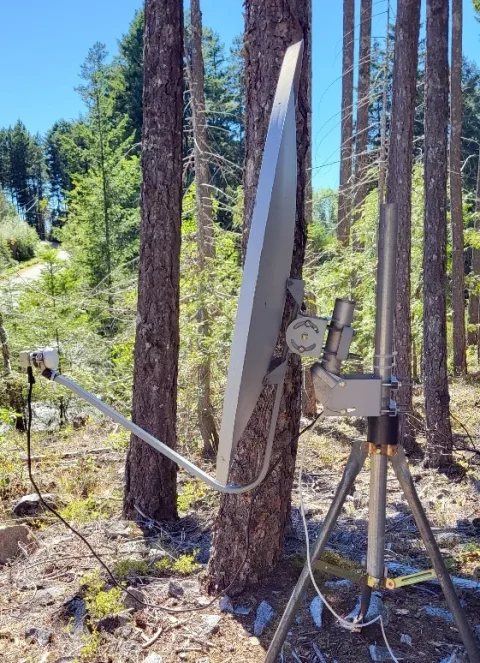
This dish is pointed at 123W. It is at 33.2 degrees elevation.

123W_cr.webp
 
  • Like
Reactions: natevw
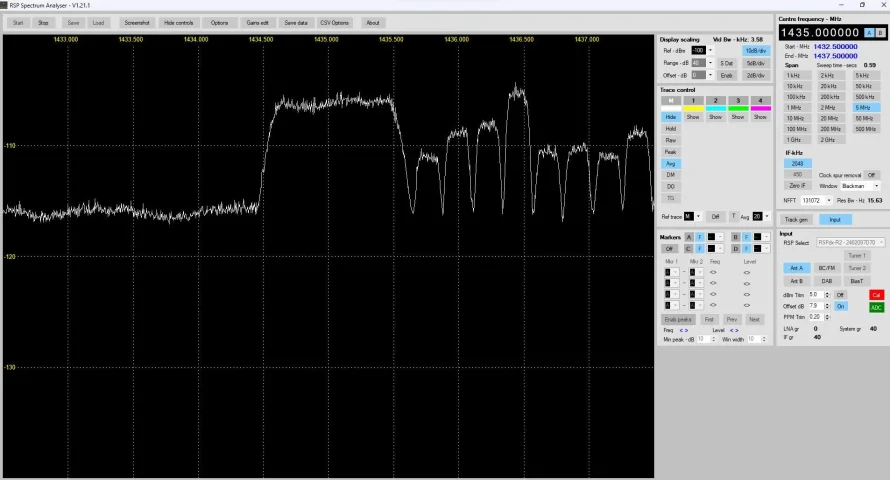
Looking with a spectrum analyzer at 11913 H from 123w, there is no signal there. Nothing near by either. Even if it was too weak to lock, the spectrum analyzer would still show a signal.
 
Looking with a spectrum analyzer at 11913 H from 123w, there is no signal there. Nothing near by either. Even if it was too weak to lock, the spectrum analyzer would still show a signal.
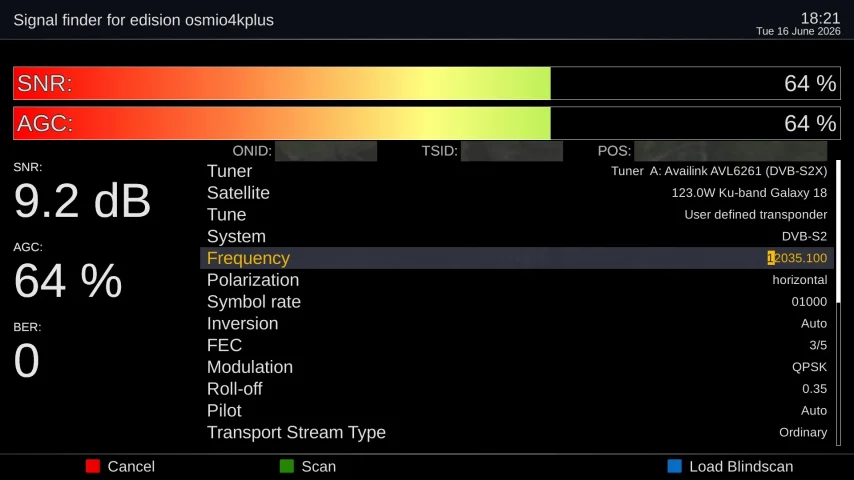
This reference says the Blockstream transponder frequency on Galaxy 18 is 12035.1 MHz Horizontal. I guess a symbol rate SR is not needed for this application since it's data and not video.

I see a strong transponder on 12034 V 19854.

1781657353411.webp
 
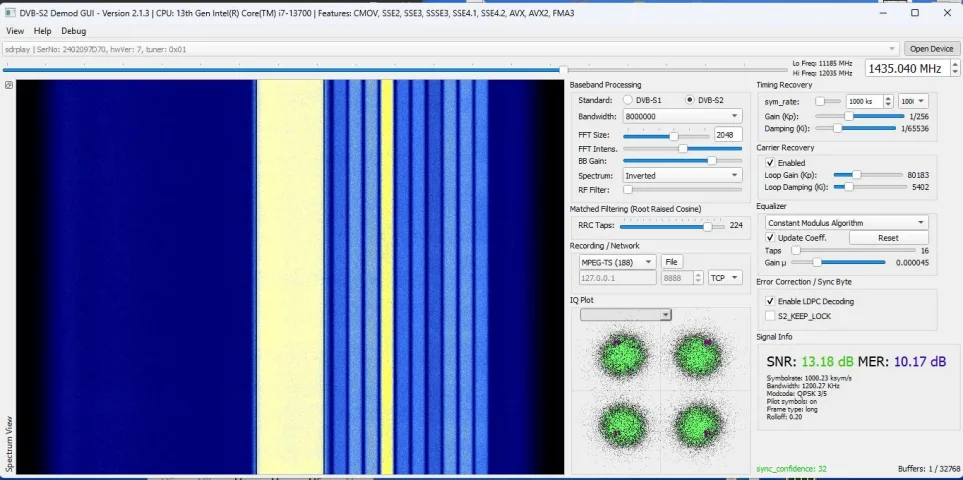
OK, I got it at 12035 H 1000. Scans in on the V9 also, but of course, no program found.
Here's a spectrum image. The 1 MHz signal in the center of the display.
 

Attachments

  • 123w 12035 H 1000.webp
    123w 12035 H 1000.webp
    125.1 KB · Views: 6
  • Like
Reactions: cyberham

AMIKO any new receivers?