Question about Ku Band LNBs

holland-observatory

Member
Original poster
Feb 25, 2026
12
5
Texas, USA
I have a question about LNBs and have been advised that this may be a good forum to get an answer. I am using the LNB on a Radio Telescope rather than a TV receiving system.

I originally experimented with measuring the temperature of the Moon with a Dish 500 system which has (2) BSNA5-506A LNBFs. After having some success with this, I purchased a larger, 1.1 meter, dish which came with a Viking Satcom Universal Single LNBF. In addition, I purchase two other LNBs to experiment with: 1) Satmaximum YL-320, 2) Geosat pro SL1 PLL.

I assumed because my Dish 500 system has been hanging on the side of my garage for around 20 to 30 years, it would be old technology and the newer LNBs would perform better. But, when testing these, the old Dish 500 LNB actually performed much better. Here is the test I am doing => When I point the dish (either Dish 500 0.5m dish or 1.1m dish) at the cold sky I get a noise floor of about -52dBFS with the Dish 500 LNB, but about -48dBFS with all three of the newer Ku Band LNBs. [ I am using an Airspy Mini SDR and SDR# software for the test. ] And, then when I then point the dish at a hot source, hot wall of our house, I get about 3.3dB rise in signal with the Dish 500 LNB, but only about 1.5dB with all of the new LNBs. I tested with DC voltages of 13V to 18V and over the frequency range of 950 to 1450MHz with consistently much better performance with the old Dish 500 LNB. I am surprised to see only a 1.5dB change between a cold sky and a hot wall.

Given that this group has members that are knowledgeable about these devices, I am wondering if anyone has experience with these that might explain the puzzling difference in performance. Also, if anyone knows of a good Ku Band LNB with a low noise floor that might do well for use in a Radio Telescope, please let me know. Thank you!

Doug Holland
 
Quick thoughts on an apples to oranges test:

Bias power source and 22KHz tone generation?

Reflector aperture beam shaping, material, accuracy

LNBF proper FD and FL setting for 1.1m reflector and LNBFs

Scalar Dish (optimized) for reflector vs linear (universal)

Signal sources on other side of wall or reflecting

LNBF Polarity Circular (Dish 500) vs Linear

Different frequency ranges:
  • Dish LNBF: 950 (IF) + 11250 (LO) = 12200 MHz (tuned frequency)
  • SL1PLL : 950 (IF) + 10750 (LO) = 11700 MHz (tuned frequency)
  • Universal LNBF: 950 (IF) without 22KHz tone + 9750 (LO) = 10700 MHz (tuned frequency)
Maybe a better test is made with a bare LNBF (without reflector) and on the same frequency (Dish 950 IF and SL1PLL 1450 IF). Polarity would be the wild card. I expect the Dish LNBF and the SL1PLL to have similar response in the above test but favoring the Dish LNBF due to the lower noise figure.

An external reference LNB mounted to a scalar matched to the reflector will provide best results. DRO type Norsat 1009x _ _ series would be worth testing. Check with the reflector manufacturer for the availability of a matched scalar.
 
Last edited:
I'm no expert (although I was a tech at a 25m radio telescope for 27 years), but I agree with Brian. You need to separate out all the factors involved in system noise temperature.

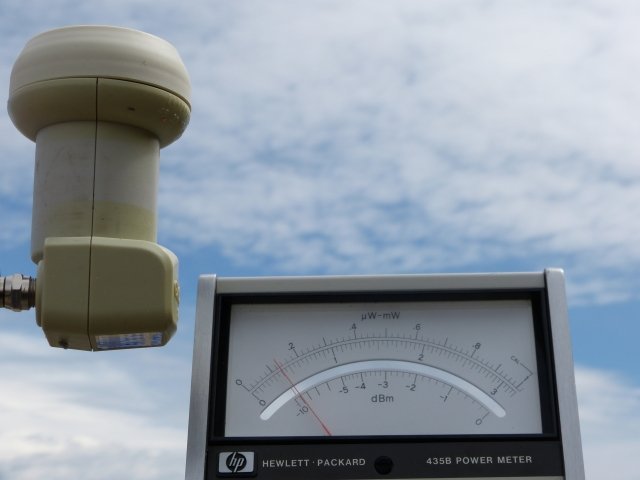
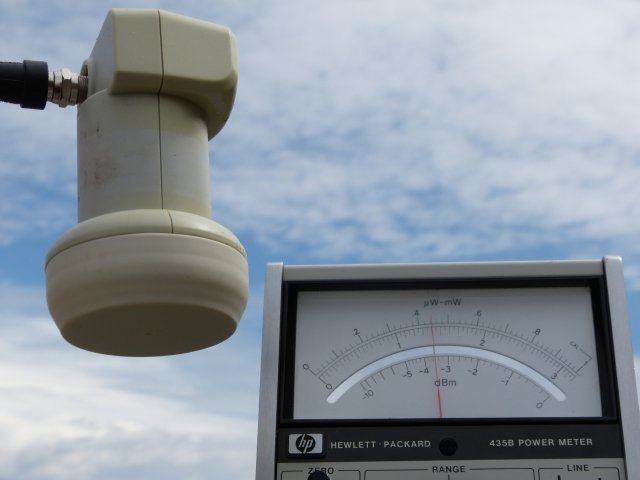
About 11 years ago I measured the difference between cold sky and warm ground using a Geosat Pro SL1 PLL LNBF. The difference was 5.4 dB. I also tested a number of other Ku band LNBFs, including from Norsat, but the Geosat was the best of the LNBFs that I had at that time.

Once you get a number for each LNBF, I'd then try them with the reflectors and figure out if there are focus or alumination issues.
 

Attachments

  • Sky.jpg
    Sky.jpg
    29.9 KB · Views: 38
  • Ground.jpg
    Ground.jpg
    30.7 KB · Views: 38
  • Like
Reactions: holland-observatory
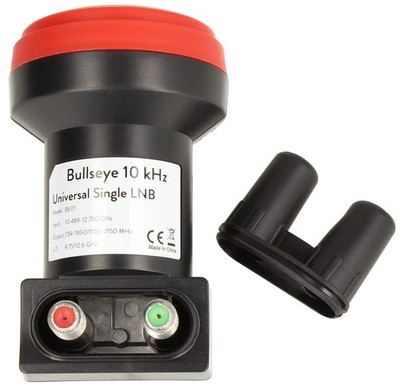
Haven't seen mention of the Othernet Bullseye lnbf. Seems to be the ku band lnbf choice of many moonbounce fans.
Surprised you haven't heard of it. I thought it was cool that when Othernet was up that you didn't even need a dish.
Anyway. Lot's of geekiness here:

Bullseye

PLEASE LOG IN TO GET RID OF THESE ADS!
 
  • Like
Reactions: holland-observatory
A number of us here are using the Bullseye LNBF. They get good reviews. Mine is very stable (<10 kHz drift), but I didn't see a big improvement in SNR. Perhaps because I'm using a 90cm dish and the dish noise temperature is a bigger factor than it would be on a 1.2m dish.

I don't know if this might be a factor, but the Starlink satellites transmit in the 11.7 to 12.2 Ghz band, but in parts of the sky away from the geostationary arc. So I'd move the dish around and see if some part of the sky is colder.
 
Quick thoughts on an apples to oranges test:

Bias power source and 22KHz tone generation?

Reflector aperture beam shaping, material, accuracy

LNBF proper FD and FL setting for 1.1m reflector and LNBFs

Scalar Dish (optimized) for reflector vs linear (universal)

Signal sources on other side of wall or reflecting

LNBF Polarity Circular (Dish 500) vs Linear

Different frequency ranges:
  • Dish LNBF: 950 (IF) + 11250 (LO) = 12200 MHz (tuned frequency)
  • SL1PLL : 950 (IF) + 10750 (LO) = 11700 MHz (tuned frequency)
  • Universal LNBF: 950 (IF) without 22KHz tone + 9750 (LO) = 10700 MHz (tuned frequency)
Maybe a better test is made with a bare LNBF (without reflector) and on the same frequency (Dish 950 IF and SL1PLL 1450 IF). Polarity would be the wild card. I expect the Dish LNBF and the SL1PLL to have similar response in the above test but favoring the Dish LNBF due to the lower noise figure.

An external reference LNB mounted to a scalar matched to the reflector will provide best results. DRO type Norsat 1009x _ _ series would be worth testing. Check with the reflector manufacturer for the availability of a matched scalar.
I will perform that test tomorrow and let you know what I find. (The test of the bare LNBFs at the prescribed frequencies.)
 
I'm no expert (although I was a tech at a 25m radio telescope for 27 years), but I agree with Brian. You need to separate out all the factors involved in system noise temperature.

About 11 years ago I measured the difference between cold sky and warm ground using a Geosat Pro SL1 PLL LNBF. The difference was 5.4 dB. I also tested a number of other Ku band LNBFs, including from Norsat, but the Geosat was the best of the LNBFs that I had at that time.

Once you get a number for each LNBF, I'd then try them with the reflectors and figure out if there are focus or alumination issues.
Can you tell me anything more about the test you did with the Geosat Pro SL1 PLL? What receiver did you use? I am using an Airspy Mini SDR for a receiver and operating in the 950 to 1450 IF range. I actually did do the LNB by itself test already, but will repeat it with the prescribed frequencies. My initial results were not impressive, still only about 1.5dB cold to hot. Will try again.
 
Can you tell me anything more about the test you did with the Geosat Pro SL1 PLL? What receiver did you use? I am using an Airspy Mini SDR for a receiver and operating in the 950 to 1450 IF range. I actually did do the LNB by itself test already, but will repeat it with the prescribed frequencies. My initial results were not impressive, still only about 1.5dB cold to hot. Will try again.
Nevermind - I can see now that you used an HP power meter. That actually is another part of this mystery. When I connect the Geosat Pro SL1 PLL to a Satellite Finder, I get a much bigger signal than when I do the same with the Dish 500 LNB. The opposite of what I get during my outdoor tests. I am just waving my hand above the LNB in an inside setting.
 
I wouldn't trust any indoor measurement. Cold sky and ground is much better.

Yes, just the HP Power meter and a power inserter to supply voltage to the LNBF. No receiver was the involved.

PLEASE LOG IN TO GET RID OF THESE ADS!
 
  • Like
Reactions: holland-observatory
A number of us here are using the Bullseye LNBF. They get good reviews. Mine is very stable (<10 kHz drift), but I didn't see a big improvement in SNR. Perhaps because I'm using a 90cm dish and the dish noise temperature is a bigger factor than it would be on a 1.2m dish.

I don't know if this might be a factor, but the Starlink satellites transmit in the 11.7 to 12.2 Ghz band, but in parts of the sky away from the geostationary arc. So I'd move the dish around and see if some part of the sky is colder.
I am pointing North in the direction of Polaris for 'cold sky'. I believe I read that this gives best results.?
 
Quick thoughts on an apples to oranges test:

Bias power source and 22KHz tone generation?

Reflector aperture beam shaping, material, accuracy

LNBF proper FD and FL setting for 1.1m reflector and LNBFs

Scalar Dish (optimized) for reflector vs linear (universal)

Signal sources on other side of wall or reflecting

LNBF Polarity Circular (Dish 500) vs Linear

Different frequency ranges:
  • Dish LNBF: 950 (IF) + 11250 (LO) = 12200 MHz (tuned frequency)
  • SL1PLL : 950 (IF) + 10750 (LO) = 11700 MHz (tuned frequency)
  • Universal LNBF: 950 (IF) without 22KHz tone + 9750 (LO) = 10700 MHz (tuned frequency)
Maybe a better test is made with a bare LNBF (without reflector) and on the same frequency (Dish 950 IF and SL1PLL 1450 IF). Polarity would be the wild card. I expect the Dish LNBF and the SL1PLL to have similar response in the above test but favoring the Dish LNBF due to the lower noise figure.

An external reference LNB mounted to a scalar matched to the reflector will provide best results. DRO type Norsat 1009x _ _ series would be worth testing. Check with the reflector manufacturer for the availability of a matched scalar.

Brian -

I did the test today that I believe is prescribed in your next to last paragraph. And, you were right. Ensuring the same input frequency, 12.2 GHz, did make a difference. I used 950 IF for the Dish 500 LNB, and 1450 IF for the Geosat SL1PLL to get a consistent 12.2 GHz input frequency. I tested the LNBs by themselves with no reflector. I tested at both 13V and 18V; 4800KHz and 600KHz bandwidth (Airspy Mini SDR with SDR# software); Four different positions: 1) Straight Up, 2) Straight Down into grass / dirt, 3) Coldest Sky area I could find, 4) House brickwall.


Here are the results -

Lowest Noise - Dish 500: -56.6dBFS, GeoSat: -55.0dBFS (both at 600KHz bandwidth, pointing at cold sky)

So, the Dish 500 was better by 1.6dB like you predicted.


Largest Signal - Dish 500: 2.4dB, GeoSat: 1.8dB (again both at 600KHz bandwidth, both comparing Straight Down into grass vs. Coldest Sky)

So, the Dish 500 did perform better, but not as much of a disparity as I had before when I was mistakenly testing at 2 different input frequencies.


Also, I did one other test considering the results that lost_mesa provided. I compared pointing Straight Up and Straight Down using a Satellite Tracker. I adjusted the Straight Up level to number '1' on the Satellite Track for both LNBs, and both of them registered '9.5' when pointed Straight Down. So, it appears a wide bandwidth test of these two give about the same results (if we consider a Satellite Tracker to be a worthy piece of test equipment).


Thank you for setting me straight on this problem,

Doug Holland
 
On a component level. From a few lnbf teardowns. Trying to look up datasheets for the individual IC's can be a crap shoot. Some have a gasfet, etc., transistor hoked to the antenna probes in the throat before the mixer IC. And some feed the H & V probes either into a switching circuit then into an all-in-one IC.

Looking for the best-of-the-best in off the shelf components for your hobby for the highest gain and lowest noise might even have you doing exactly what you are doing. Experiment with different stuff.
Why did my Titanium C2-W let considerable circular polarized signals come in and my orthomode does not without using a depolarizer? Better yet. When I get a light dusting of snow on the lower half of my dish. Circular transponders come in a few dB more? Ain't microwaves fun?

A couple of thoughts. When c band started showing up and there were tons of manufacturers, installers capitalizing on the home user business. We separate had LNA's and downconverters attached either with Type N to N couplers, short chunks of coax.
And the LNA's were rated by degrees Kelvin. LNA's were built basically by hand picking the active and passive components. A 22K LNA and 11K could be built on the same bench. Measure the specs and sticker it accordingly. Relate to the trusty old CK 722 transistor. I believe that I read when transistorized hearing aids came out. The CK 722 were actually the ones that didn't make the cut. mmm.....What WERE the originals that did?

Sometimes I get freaky and hard to find noisy components. Bad solder pads. Stuff. Hot air and freeze spray? Priceless. And Germanium transistors, transistors that have gone "black lead"...hissy diodes. Cripes!
Freeze spray. Lower the Kelvin temperature. Cool down the atomic noise. Like the DSN does by chilling the feed components. I looked. There are in fact cryo cooled LNA and feed components for the big boys.
What if....just if. You packed a bag of dry ice around your lnb? Or gave it a good shot of a CO2 fire extinguisher while looking at your signal stats?

...i may be out there but i ain't THAT far out.
 
  • Like
Reactions: holland-observatory
Haven't seen mention of the Othernet Bullseye lnbf. Seems to be the ku band lnbf choice of many moonbounce fans.
Surprised you haven't heard of it. I thought it was cool that when Othernet was up that you didn't even need a dish.
Anyway. Lot's of geekiness here:

Bullseye

On a component level. From a few lnbf teardowns. Trying to look up datasheets for the individual IC's can be a crap shoot. Some have a gasfet, etc., transistor hoked to the antenna probes in the throat before the mixer IC. And some feed the H & V probes either into a switching circuit then into an all-in-one IC.

Looking for the best-of-the-best in off the shelf components for your hobby for the highest gain and lowest noise might even have you doing exactly what you are doing. Experiment with different stuff.
Why did my Titanium C2-W let considerable circular polarized signals come in and my orthomode does not without using a depolarizer? Better yet. When I get a light dusting of snow on the lower half of my dish. Circular transponders come in a few dB more? Ain't microwaves fun?

A couple of thoughts. When c band started showing up and there were tons of manufacturers, installers capitalizing on the home user business. We separate had LNA's and downconverters attached either with Type N to N couplers, short chunks of coax.
And the LNA's were rated by degrees Kelvin. LNA's were built basically by hand picking the active and passive components. A 22K LNA and 11K could be built on the same bench. Measure the specs and sticker it accordingly. Relate to the trusty old CK 722 transistor. I believe that I read when transistorized hearing aids came out. The CK 722 were actually the ones that didn't make the cut. mmm.....What WERE the originals that did?

Sometimes I get freaky and hard to find noisy components. Bad solder pads. Stuff. Hot air and freeze spray? Priceless. And Germanium transistors, transistors that have gone "black lead"...hissy diodes. Cripes!
Freeze spray. Lower the Kelvin temperature. Cool down the atomic noise. Like the DSN does by chilling the feed components. I looked. There are in fact cryo cooled LNA and feed components for the big boys.
What if....just if. You packed a bag of dry ice around your lnb? Or gave it a good shot of a CO2 fire extinguisher while looking at your signal stats?

...i may be out there but i ain't THAT far out.
For some reason, I cannot reply to your posts. I keep getting an error.
On a component level. From a few lnbf teardowns. Trying to look up datasheets for the individual IC's can be a crap shoot. Some have a gasfet, etc., transistor hoked to the antenna probes in the throat before the mixer IC. And some feed the H & V probes either into a switching circuit then into an all-in-one IC.

Looking for the best-of-the-best in off the shelf components for your hobby for the highest gain and lowest noise might even have you doing exactly what you are doing. Experiment with different stuff.
Why did my Titanium C2-W let considerable circular polarized signals come in and my orthomode does not without using a depolarizer? Better yet. When I get a light dusting of snow on the lower half of my dish. Circular transponders come in a few dB more? Ain't microwaves fun?

A couple of thoughts. When c band started showing up and there were tons of manufacturers, installers capitalizing on the home user business. We separate had LNA's and downconverters attached either with Type N to N couplers, short chunks of coax.
And the LNA's were rated by degrees Kelvin. LNA's were built basically by hand picking the active and passive components. A 22K LNA and 11K could be built on the same bench. Measure the specs and sticker it accordingly. Relate to the trusty old CK 722 transistor. I believe that I read when transistorized hearing aids came out. The CK 722 were actually the ones that didn't make the cut. mmm.....What WERE the originals that did?

Sometimes I get freaky and hard to find noisy components. Bad solder pads. Stuff. Hot air and freeze spray? Priceless. And Germanium transistors, transistors that have gone "black lead"...hissy diodes. Cripes!
Freeze spray. Lower the Kelvin temperature. Cool down the atomic noise. Like the DSN does by chilling the feed components. I looked. There are in fact cryo cooled LNA and feed components for the big boys.
What if....just if. You packed a bag of dry ice around your lnb? Or gave it a good shot of a CO2 fire extinguisher while looking at your signal stats?

...i may be out there but i ain't THAT far out.
Thank you for the input. I have been cooling my SDR to keep it cool and regulate its temperature. I have thought about cooling the LNAs and LNBs too. Thanks!
On a component level. From a few lnbf teardowns. Trying to look up datasheets for the individual IC's can be a crap shoot. Some have a gasfet, etc., transistor hoked to the antenna probes in the throat before the mixer IC. And some feed the H & V probes either into a switching circuit then into an all-in-one IC.

Looking for the best-of-the-best in off the shelf components for your hobby for the highest gain and lowest noise might even have you doing exactly what you are doing. Experiment with different stuff.
Why did my Titanium C2-W let considerable circular polarized signals come in and my orthomode does not without using a depolarizer? Better yet. When I get a light dusting of snow on the lower half of my dish. Circular transponders come in a few dB more? Ain't microwaves fun?

A couple of thoughts. When c band started showing up and there were tons of manufacturers, installers capitalizing on the home user business. We separate had LNA's and downconverters attached either with Type N to N couplers, short chunks of coax.
And the LNA's were rated by degrees Kelvin. LNA's were built basically by hand picking the active and passive components. A 22K LNA and 11K could be built on the same bench. Measure the specs and sticker it accordingly. Relate to the trusty old CK 722 transistor. I believe that I read when transistorized hearing aids came out. The CK 722 were actually the ones that didn't make the cut. mmm.....What WERE the originals that did?

Sometimes I get freaky and hard to find noisy components. Bad solder pads. Stuff. Hot air and freeze spray? Priceless. And Germanium transistors, transistors that have gone "black lead"...hissy diodes. Cripes!
Freeze spray. Lower the Kelvin temperature. Cool down the atomic noise. Like the DSN does by chilling the feed components. I looked. There are in fact cryo cooled LNA and feed components for the big boys.
What if....just if. You packed a bag of dry ice around your lnb? Or gave it a good shot of a CO2 fire extinguisher while looking at your signal stats?

...i may be out there but i ain't THAT far out.
Thank you for the input. I have been cooling my SDR to reduce the noise and regulate its temperature. I have thought about doing the same for the LNAs and LNBs too. Thanks!

PLEASE LOG IN TO GET RID OF THESE ADS!
 
  • Like
Reactions: arlo
Haven't seen mention of the Othernet Bullseye lnbf. Seems to be the ku band lnbf choice of many moonbounce fans.
Surprised you haven't heard of it. I thought it was cool that when Othernet was up that you didn't even need a dish.
Anyway. Lot's of geekiness here:

Bullseye
I did find the Othernet Bullseye when I was researching LNBs. But, I could not find a place to buy one.
 
Last edited:
They are available on eBay. Search for QO-100 Bullseye.

I ordered one yesterday from madsyentist. Looks like it is coming from Chicago. The previous one I purchase was from an eBay seller in New Zealand and it shipped from China.
 

Multiple dishes, one with a motor: switch question