5g interference

Advertisements
I guess the C140 was a waste of money. Looks like I won't be watching much C-band anymore.
Might not even be 5G interference. What is the CNR on 4032V15201 on 117W when it is decoding reliably? As it is DVB-S 5/6, should decode reliably to approx. 6.5dB C/N. If your CNR doesn't have adequate headroom above 6.5 dB (minimum recommended C/N), other minimal factors may be affecting the reception.

5G interference is usually exhibited as fluctuation of lock/unlock (steady video and sound then microblocking and stuttering audio repeating cycle) as the Forward Error Correction (FEC) attempts to gather enough uncorrupted bits to correct the errors and begin decoding again. I wouldn't expect the CNR just to drop to 0dB and remain.

Try shifting the TP frequency to the published 4031 MHz +/- 1, 2 or 3 MHz. This frequency is very close to the filter bandpass, so the C140 attenuation slope is typically 25db and ramping up near the filter edge.

If this is the result of 5G interference, you might need a tighter filter such as an inline mechanical waveguide on a feedhorn in addition to an 4000-4200 MHz BPF LNB and maybe even build a RF fence to block the source.
 
Might not even be 5G interference. What is the CNR on 4032V15201 on 117W when it is decoding reliably? As it is DVB-S 5/6, should decode reliably to approx. 6.5dB C/N. If your CNR doesn't have adequate headroom above 6.5 dB (minimum recommended C/N), other minimal factors may be affecting the reception.
15.1 dB with occasional drops to 0 and back to 15.1 dB
5G interference is usually exhibited as fluctuation of lock/unlock (steady video and sound then microblocking and stuttering audio repeating cycle) as the Forward Error Correction (FEC) attempts to gather enough uncorrupted bits to correct the errors and begin decoding again. I wouldn't expect the CNR just to drop to 0dB and remain.

Try shifting the TP frequency to the published 4031 MHz +/- 1, 2 or 3 MHz. This frequency is very close to the filter bandpass, so the C140 attenuation slope is typically 25db and ramping up near the filter edge.
I tried higher freq transponders on this sat with same results. I have this issue on other sats (99, 101, 103) also.
If this is the result of 5G interference, you might need a tighter filter such as an inline mechanical waveguide on a feedhorn in addition to an 4000-4200 MHz BPF LNB and maybe even build a RF fence to block the source.
Don't know if it's worth the expense to change to a LNB/servo or dual output LNB. I have 2 C-band antennas exhibiting this problem.
 
  • Like
Reactions: Titanium
15.1 dB with occasional drops to 0 and back to 15.1 dB

I tried higher freq transponders on this sat with same results. I have this issue on other sats (99, 101, 103) also.

Don't know if it's worth the expense to change to a LNB/servo or dual output LNB. I have 2 C-band antennas exhibiting this problem.
I live practically right next to two 5G towers and when they went live they wiped out everything on C band. I installed the C140 and have watchable signals again with one exception; aircraft radar. I'm in the flight path for two major airports and when the planes turn around over the pacific and head back towards land the radar signals completely overwhelm the LNBF. Watching it on a spectrum analyzer is quite the sight to see. Do you have any radar installations in the vicinity?
 
  • Like
Reactions: FTA4PA
I live practically right next to two 5G towers and when they went live they wiped out everything on C band. I installed the C140 and have watchable signals again with one exception; aircraft radar. I'm in the flight path for two major airports and when the planes turn around over the pacific and head back towards land the radar signals completely overwhelm the LNBF. Watching it on a spectrum analyzer is quite the sight to see. Do you have any radar installations in the vicinity?
None that I know of.
 
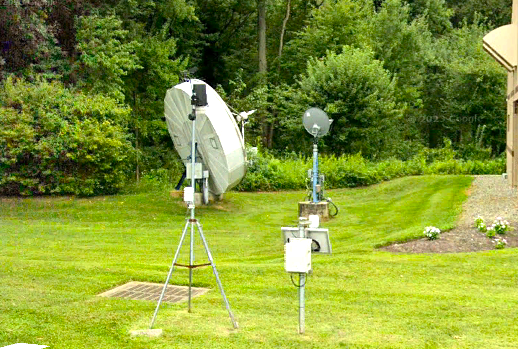
This was very interesting to find. A NOAA weather station outside of Philly. Aimed most probably at 121W on the NOAAPort tp.
Never really saw a shield on anything but microwave link dishes on towers.
Pretty cool, huh!
 

Attachments

  • NOAAPort Dish}.png
    NOAAPort Dish}.png
    475 KB · Views: 90
  • Like
Reactions: texanboy
Looks like a reflector heater enclosure for snow and ice. Note that the enclosure is mounted on the back of the reflector. Warm air is exhausted into the enclosure to heat the dish and prevent build-up of ice and snow on the reflector's surface.
 
  • Like
Reactions: primestar31
I am using titanium's LNBF (C140), however I am still getting signal drop (Q 75% - to 0%) in some western arc satellites.

What I tried to fix:
1- fine tuned the dish but still not helping. (It is better at night time, but during day, almost impossible to get the images due to pixelation)
2- build an aluminum super feed horn and added around the feed horn w/o success


what else do you all try to get the 5G interference minimized w.o moving the dish?
 
Update: I just got an aha moment!
There is a nearby airport on my west, possible radar causing severe interference in my western arch satellites.

It is just my gut feeling. maybe I am wrong. I was tweaking around the dish wrapping some aluminum foils around the feed horn for hours, possibly my neighbors thinking me as a crazy person playing around the antenna for hours :)

Also, pixelation is in the entire 4.0-4.2 GHz spectrum. all TPs has thhe issue. I assume 5G cellular interference is limited to lower end.

Good weekend to you all!
 
  • Like
Reactions: FTA4PA and navychop
Aviation radio altimeters operate between 4.2 and 4.4GHz. The C140 and C240 LNBFs are designed to filter below 4.2GHz and pass 4.0 to 4.2GHz. We left the top of the bandpass open as the majority of users do have a need for filtering above 4200MHz. Aviation radio altimeter interference only occurs in areas which are in very close proximity to larger regional and international airports (not typically available in smaller facilities).

Your best solution to address both the 5G and the altimeter interference sources is to use a LNB with 4000-4200 band pass and install waveguide mechanical filters, which attenuate below 4000MHz and another to filter above 4200MHz. Not inexpensive, but an option. :eek:

You might get away with moving the dish behind a structure (or build a RF blocking hardware cloth wall) to block the low elevation terrestrial based Aviation radio altimeter signals. Reminds me of the early C-band days when long line AT&T microwave caused interference. We would do a sight survey using a trailered BUD and often suggest to the customer that we install the dish behind an outbuilding to shield it from the microwave telephone point to point microwave links.
 
Are you less susceptible to interference the larger your dish? the only dish left that doesn't have a filter is my 12', and I have just run into a situation where there is a transponder i cannot pick up any more, but i can pick it up on my smaller 10' that has a filter. I went outside and checked fine-tuning and everything seems good. I re-peaked it, and i still cannot get the transponder with my 12'. But, im not having any break ups or jitters on any of the other transponders like i have experienced on my other smaller dishes with 5g interference.
 
Not a lot to go on here, but....
The size of the dish can provide a narrower beamwidth, but it is no more or less susceptible to terrestrial interference. Terrestrial interference either enters the feedhorn directly from the sides or as a reflection off of the dish or other nearby surfaces. A deeper dish with better FD ratio is better at rejecting terrestrial interference. Could also be an issue with the scalar setting and rejection of adjacent satellite interference.

What is the transponder frequency, symbol rate and FEC? Does the SQ drop out randomly or never lock?
 
Sorry for the delay.. Busy day yesterday. The signal never locks, except on one occasion, I left it on the service for hours, I came back and realized at some point a signal was momentary locked, because i had a partial image on the tv.

4180 34284 5/6
 
Sorry for the delay.. Busy day yesterday. The signal never locks, except on one occasion, I left it on the service for hours, I came back and realized at some point a signal was momentary locked, because i had a partial image on the tv.

4180 34284 5/6
Not characteristic of 5G C- band interference. Do you have access to a spectrum analyzer?
 
Not characteristic of 5G C- band interference. Do you have access to a spectrum analyzer?

No. I suppose i can try a spare lnbf. I have a few being i've swapped a few for the filtered one. This just happened less than a week ago. I had no issues with the signal before that, and like i said, i can swing my 10' over and pick up the transponder without issue. We haven't had any wind storms and i fine tuned it a bit and made no progress.
 
Well.. I have yet to do anything since i fine-tuned and still had no signal. However, at the moment, the transponder is beaming in perfectly at a higher dB than before i fine-tuned. I don't know what's up? Some temporary interference, or if its a fluke that i am getting the signal lock now and it will be gone tomorrow.
 

Auction of the Upper C-Band Frequencies

Testing the Titanium C140 and C240 5G Filtered BLUE LNBFs